Tag: atheism

  • Does Atheism Solve the Problem of Evil?

    Does Atheism Solve the Problem of Evil?

    Recently, I was listening to a Cross Examined podcast with Frank Turek where he was interviewing Oxford mathematician and Christian philosopher John Lennox on a lecture titled “If God, Why Evil?” I love listening to Lennox speak because he has a mastery of this subject matter and he is such an amazingly clear and concise communicator and thinker. Much like Ravi Zacharias in the way he communicates, there are few that can communicate complex topics as winsomely and persuasively as he does. Lennox is truly one of the finest Christian intellects of our generation and there are few more qualified to provide authoritative insights into the nature of the problem of evil than he.

    As I was listening, he brought up a side of the problem of evil that I haven’t examined much before until recently. As he described it, those that choose not to believe in a God because of the existence of evil fail to understand that atheism does not adequately solve the problem of evil in the most important respect. Atheism removes hope from the equation entirely. With God, we are certain of the existence of hope regardless of how poor our understanding is of the existence of evil. Those that become upset with the tragedies of this life and resort to atheism as a solution are failing to comprehend that the problem of evil and suffering will exist nonetheless. There are a couple conundrums that atheism faces when attempting to serve as an adequate explanatory framework for evil and suffering…

    If Atheism is True, No Hope Exists

    http://www.youtube.com/watch?v=Ugb8St6az_Q

    The video above beautifully and simply addresses the problems that arise when atheism attempts to answer the intellectual problem of evil. Many atheists would point out that the hopelessness of our universe does not mean that their atheistic answer to suffering and evil is incorrect. I wholeheartedly agree. The hopefulness or hopelessness of an argument is irrelevant. The question must inevitably arise however, how comprehensively has atheism truly answered this question if in the process of removing God; they’ve also removed any remnant of hope that would emotionally help them through their suffering? Lennox states, “There is a sense in which atheism does solve the intellectual problem, but we have to notice that it doesn’t take away the suffering”. This is the problem with the atheistic position that many bypass in their intellectually clumsy desire to remove a God that would permit evil to exist. While the problem of evil may very well be perceived as a problem for the Christian, the Christian can at least “have hope in the face of suffering” unlike the atheist who has no hope while suffering and must face the grim reality of death being the ultimate end of their existence after a lifetime of suffering evil.

    Nature of God

    It will help us answer the question further to learn more about the nature of God. For the Christian, Jesus is God incarnate and came to die on a cross for our sins and rose on the third day, showing that “God has not remained distant from our suffering but has become a part of it”. God has endured more suffering than we can imagine and the suffering he endured was part and parcel of our salvific relationship we can choose to have with Him. Our fallen nature has brought upon most of the evil that we observe within creation and God took it upon Himself to rectify the misdeeds of His creation through the suffering on the cross so that we may have the opportunity, if we so choose, to give our lives to Him and receive eternal salvation (i.e. hope).

    The atheistic critique that God would be the author of evil in spite of Him voluntarily subjecting himself to the very evil that He is accused of creating is farcical. Jesus Christ voluntarily gave His life for us in an incomprehensibly excruciating death while begging the Father to extend forgiveness to His executioners because they ‘do not know what they do’. It seems that through Jesus’ life on earth, he experienced His fair share of evil and suffering. Jesus saw disease, death, violence, prostitution, thievery, and brokenness of every stripe. Jesus “became a part of it” and brought more hope than we deserve along with him. If atheists claim that evil and suffering are incompatible with the existence of God, it’s their claim to prove. While freewill allows for moral virtue, it also allows for the possibility of horrendous evil. The fact that God loves us enough to allow us to make our own choices is also reflective of His loving nature. God’s gift of freewill among mankind does not make God morally responsible for the evil choices freely made among those who chose to do evil instead of good.

    Conclusion

    In the grand scheme of things, if atheism is true, there is no hope for any sort of ultimate justice or compensation. Those that commit atrocities throughout history like Hitler, Stalin, and Mao will not receive punishment for their atrocities. Those who lived a righteous God-fearing life would have ultimately lived a life of virtue in vain. Lennox adds that he believes that “it could be argued that atheism makes it worse because now there is no hope”. Regardless of the existence of hope, we must ask ourselves where the evidence points.

    The existence of objective moral values and duties serves as a valuable piece of philosophical evidence. We typically don’t have to be told that murder, stealing, theft is immoral because it is self evident. God has written a transcendent moral law on our hearts so that we know that an objective moral standard exists. Without an objective standard, how can we truly measure whether an action is morally good or evil with objectivity? Some declare that morals are merely subjective and dependent on the individual person or society. However, when someone steals their car they’ll be the first complaining about how immoral stealing is. Just remind them, ‘that person must believe stealing is morally permissible so you really shouldn’t be upset’. Moral relativism is truly unlivable. If you don’t believe me, look in the history books and see how many millions of people who died under the morally relativistic atheistic dictatorships of the 20th century.

    If Jesus was who he claimed to be, which I contend that he is, we can be sure that the existence of suffering and evil is not incompatible with the existence of God. Jesus himself lived through evil and conquered it by rising on the third day. In the end, those that resort to atheism to solve this problem are left empty handed. Not only is the moral evidence for atheism deficient but other areas of study have provided strong compelling arguments for the existence of God that further corroborate the conclusion that suffering and evil should not be the roadblock that keeps one from accepting Jesus as Lord and Savior. Jesus has provided us the hope that we need to get through times of suffering and can give us the strength to fight the evil that may attempt to engulf our lives.

  • The Failure of the Atheistic Meme

    The Failure of the Atheistic Meme

    Social media has become a breeding ground for memes that address pop culture, politics, religious, etc… I’m exposed to a ton of religiously motivated memes from both Christian and atheistic camps. Admittedly, I’ve seen some funny ones over the years but I’ve also seen some grossly misleading ones. Christians aren’t innocent of partaking in the spreading of ridiculous memes and I feel they should be held accountable when they spread nonsense via meme over social media. However, I’m devoting this article to addressing some popular atheistic memes that won’t seem to go away. In my opinion, these are memes that are completely undeserving of the recognition they’ve received. I have selected five memes (there are many more) that seem to have gained a lot of traction among popular atheistic social media sites.

    The reason for me addressing this particular topic is because I’ve personally observed skeptics who find these meme-arguments to be top-notch. This type of lazy thinking doesn’t benefit anyone and the tone that it sets is destructive for those who genuinely desire to have a constructive dialogue. Some may think that I’m taking these memes too seriously, and I would be inclined to agree. These memes are undeserving of any serious consideration most of the time. However, what about those who are young in their faith and are not equipped to thoroughly respond to these memes that are written to appear pseudo-sophisticated? It’s important for those that are persuaded by these atheistic meme-arguments and those that truly feel challenged by them to understand that these memes largely fail when attempting to advance arguments that challenge the opposing position. Some people, like myself, take these little memes with a grain of salt but others unfortunately become influenced by them.

    We should let the meme-content speak for itself and not dismiss it because it’s merely a meme; that would be a fallacy. With that being said, let’s give these memes some serious thought and judge them on the basis of their own merits…  

    1.

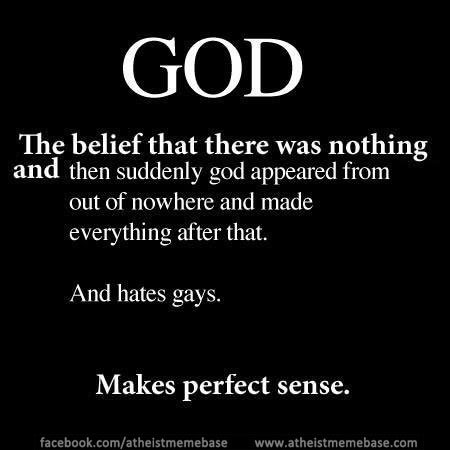
    Atheist meme 3

    The irony of this meme is obvious once you begin to assess the wording and apply the same standard to atheism. If you replace ‘god’ with ‘the universe’ in this meme you’ll have the following sentence…. “The belief that there was nothing and then suddenly the universe appeared out of nowhere and that made everything after that.” This sentence is precisely what atheists are required to believe to loyally adhere to atheism. Atheism and materialism are bedfellows that strictly prohibit anything from being explained outside of material causes. So, does the universe popping into existence out of nothing make ‘perfect sense’? Not to me and not to most people. There have been no scientific observations made that support the claim that material has the power to cause its own existence.

    This meme also makes a false presupposition from the get-go; it assumes that God began to exist and then subsequently created everything. The very nature of God is an eternal being without a beginning. The notion of a finite god doesn’t meet the definition of God. If there is a God, the existence of the universe and everything within it would be contingent upon Him, the Creator.

    The last statement, “and hates gays” is just ridiculous. This is the poorly articulated ridicule that shuts down substantive dialogue.

    2.


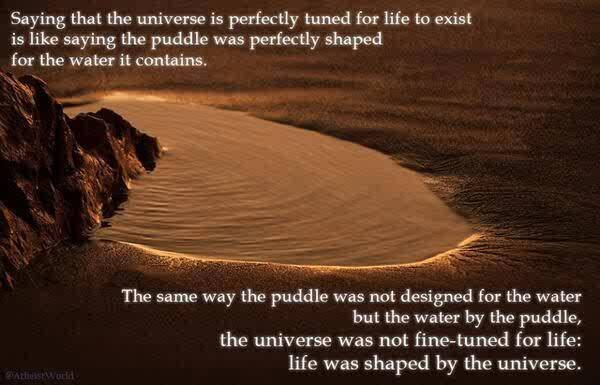
    Atheist meme 1

    The author of this meme is attempting to claim that fine-tuning doesn’t exist by attempting to make a parallel between the elements of fine-tuning observed in our universe and water forming to the shape of the pond. However, does this seemingly clever little parallel hold water? The answer is no. As much as the author wants to attribute all of the fine-tuning for the existence of habitable universe and intelligent life-forms to mere physical necessity (i.e. it couldn’t have been any other way), the reality is that the universe could be much different. In fact, the existence of the universe being uninhabitable is incomprehensively greater than observing a universe that is habitable for intelligent life.

    Below is a video that effectively describes the fine-tuning argument:

    http://www.youtube.com/watch?v=UpIiIaC4kRA

    After viewing the video, the analogy used in the meme falls apart. The universe couldn’t ‘shape’ life if the constants and quantities weren’t precisely tuned to allow for living organisms to exist. Given the vast number of constants and quantities that had to fall within a very narrow life-permitting range, the likelihood of chance or physical necessity being the most probable explanation is nearly impossible.

    3.

    Atheist meme 7

    To dismiss the entire idea of intelligent design on the basis of perceived natural flaws is like saying that Disney World is a product of random chance because Splash Mountain was closed due to mechanical difficulties. There are lots of examples that illustrate the absurdity of this meme’s message. Are vehicles not designed when it is discovered they have engineering flaws? Are paintings not painted by artists when imperfections are discovered? Are books without authors if a letter is misspelled? Reality evidences the fact that designs do not require perfection in order to be designed. This meme is about as evidentially valid as saying that Mt. Rushmore was the product of wind and erosion.

    4.

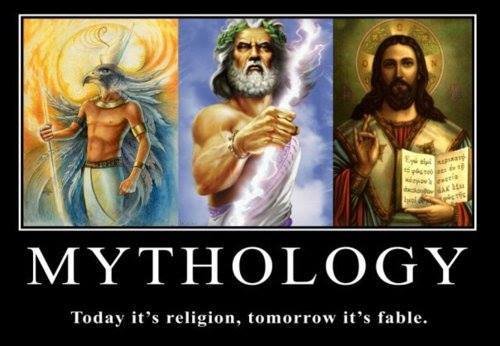
    Atheist meme 4

    I’m assuming the intention of the meme is to compare Jesus to other mythological gods by assuming that Jesus was developed on a fictitious basis and was eventually deified on a global scale. Unlike Zeus and his band of mythological brothers, the historical narrative of Jesus is firmly rooted in historical evidence. What the meme conveniently fails to mention is the fact that a persuasive historical case can be made for the resurrection of Christ. On the whole, the vast majority of modern New Testament scholarship (including popular Biblical scholar and skeptic Bart Erhman) openly accepts that Jesus was a historical individual and that his life and ministry was chronicled reliably. While not all New Testament scholars accept the resurrection as a historical reality, they concede that much can be known about the historical Jesus because of the abundant amount of reliable sources about his life and ministry. The historical evidence is what separates Jesus from any figure of mythology.

    5.

    God beheading me

    The “God” page has almost two million ‘likes’ on Facebook. Wow… In brief summary, this page is a mockery of the Biblical God. If one were to skim through the page, it would soon be clear that the page is designed to invoke humor at God’s expense. While the humor may be lighthearted at times, I’ve observed posts that are directly pointed at God/theists in a negative way; like the picture above.

    When I see comments like this, I ask myself a couple different questions. 1) Are you familiar with 20th century history? And 2) How can you make an objective moral judgment without the existence of a transcendent moral standard that can only be provided by a moral law giver? In the video below, Ravi Zacharias beautifully answers both of these questions together…

    http://www.youtube.com/watch?v=0218GkAGbnU

    After viewing this short video addressing these questions, does the meme have the same rhetorical impact? Clearly not. Regardless of which method one chooses to murder, atheistic dictatorships have been responsible for more killing in the 20th century than the total amount of deaths from all religious actions combined. It was Fyodor Dostoyevsky who said, “If God is not, everything is permitted.” When these atheistic dictators loyally adhered to their worldviews, history has proven that atheism is a much more dangerous worldview due to the lack of objective moral prohibitions.

    It may be considered trendy to make these types of comments when ISIS beheadings are frequently happening in the Middle East in an attempt to portray atheism as being morally superior. This attempt at moral superiority is vain. Trying to portray the atheistic worldview in a morally superior light isn’t supported by historical evidence or philosophical reasoning.

    Conclusion

    My goal with this post is to challenge people to think beyond the common meme arguments that are used by many internet infidels online. I cannot comprehend why anyone would advance an argument through a meme but since they are becoming increasingly prevalent in social media, I felt it was worth a post to address the more common memes I’ve seen.

    I know atheists are not the only guilty parties in the war of the memes on social media. I discourage all Christians from posting fallacious memes that advance poorly articulated thoughts and arguments. This is not a way to advance the Word. As we’ve seen above, simply because it may sound clever on the surface doesn’t mean that it’s a good argument for your position.

    Lastly, if you can’t help yourself…post a cute meme of a puppy or something. Everyone loves puppies.

  • Death by a Thousand Paper Cuts

    Death by a Thousand Paper Cuts

    I recently had the genuine privilege of attending a lecture at Ohio State University hosted by Ratio Christi where J Warner Wallace gave a lecture titled “The Bible on Trial”. Personally, I have been blessed enough to become personally acquainted with J Warner Wallace by attending Cross Examined Instructors Academy (CIA) in August 2013 where he was one of the instructors. Coincidentally, Jim and I stayed at the same hotel along with multiple other CIA students while attending CIA in North Carolina at Southern Evangelical Seminary. Since we were all staying at the same hotel, it seemed to make sense that we all meet for breakfast. We were all tremendously excited to partake in a meal with Jim and talk about apologetics. With all of us having read Cold Case Christianity, we knew of Jim’s cold-case investigative background and were fascinated by his unique outlook and evidential approach to the Christian faith. We, as novice apologists by comparison, were eating up every moment we had with Jim in the morning. From my perspective, what serves as the most powerful tool in Jim’s bag is his natural ability to develop and persuasively communicate a cumulative case for the historicity of the Bible. This is what he calls, “death by a thousand paper cuts”. Meaning that after so many pieces of circumstantial evidences are gathered, one cannot escape reaching the conclusion that Jesus is a historical person and that he was who he said he was.

    Breakfast with J Warner Wallace

    The phrase “death by a thousand paper cuts” is one that has stuck with me since I heard it. This approach is not solely unique to J Warner Wallace even though Jim is among the best implementers of it. You can see this approach illustrated among the best Christian thinkers of our time. For those that make a solid case for Christianity, they use multiple arguments to make their cumulative case as to provide a more impactful effect on those they intend to persuade. For example, if an atheist wants to convert me from my Christianity to atheism, he will need a very strong cumulative case that refutes all of my presently held beliefs that persuade me that Christianity is true. Obviously, one argument is not going to dissuade me from believing in evidence for Christianity such as objective morality, fine-tuning of the universe, and the resurrection of Christ. An atheist would need multiple arguments to build a compelling cumulative case as to why I should consider atheism as a more reasonable explanation of reality than Christian theism. The same is true for the Christians who want to convince unbelievers of the truth claims of Christianity.

    Given the ‘death by a thousand paper cuts’ approach, what are the most effective arguments for the existence of Christian theism that will help build up a solid case for the Christian worldview in the face of skeptics in a way that shows the perfect alignment that Christianity has with reality? While there are dozens of arguments for the existence of Christian theism, there are some that pack more punch than others. The prominent Christian philosopher William Lane Craig uses many of the same arguments in most of his debates on the existence of God for a good reason. That reason is because they are effective and that skeptics have never replied in a manner that served as a reasonable refutation of these arguments.

    The arguments that are put forward by Christian apologists encompass theology, philosophy, science, and history. A proficiency in all of these areas will assist in one’s capabilities as an effective apologist. As J Warner Wallace likes to put it, we need to strive towards being a competent ‘One Dollar Apologist’. This phrase was not meant to imply that we should sell ourselves short and not make an attempt to be the best case-makers we can be. Being a ‘One Dollar Apologist’ essentially implies that everyone is not destined to be the next William Lane Craig, Ravi Zacharias, John Lennox, Frank Turek, Josh McDowell, and the like. It is not realistic to think that all of us will get our doctorate in philosophy or theology and publish mainstream literature and influence an entire culture. However, a One Dollar apologist can make a significant difference within his or her own scope. A One Dollar apologist can be just as effective within our own sphere of influence if we are prepared to do so. It is true that we can occasionally reach unbelievers in a way that the bigger names in apologetics cannot because of our specific placement in an unbeliever’s life. We have the ability to develop personal relationships and show direct love to people in a way that is not possible for the ‘Million Dollar’ apologist! Basically, be proud to be a One Dollar Apologist!

    All apologists from all backgrounds need to know which arguments to be fluent in if they are ever in a position to make the case for their Christian faith to a skeptic. I will list what arguments I feel are absolutely necessary to be familiar with for a strong cumulative case. Think of it as your ‘Essentials Kit’ for Christian apologetics and these arguments will serve as the foundation for making a sound cumulative apologetic for Christianity. I will provide a brief summary of the argument and follow it up with a informative video of the argument that will describe it in more detail.

    Kalam Cosmological Argument

    This is one of my favorite scientific and philosophic arguments for the existence of a personal theistic God. Obviously, this argument was not designed to prove the Christian religion true specifically. However, it does show that the cause of the universe must have properties that are consistent with a personal, all knowing, and all powerful God. Below is the structure of this argument:

    1) Anything that begins to exist has a cause
    2) The universe began to exist
    3) Therefore, the universe had a cause

    The Fine-Tuning Argument

    Many nonbelievers consider this argument for the existence of God to be the most scientifically persuasive. I would have to largely agree with them. Trying to account for all of the laws, constants, and quantities that can be objectively measured and observed within our universe from a naturalistic framework requires much more faith than the design hypothesis because the odds against these various conditions being the way they are by chance is so incomprehensibly small as to be make the naturalistic hypothesis nearly impossible. Below is the structure of this argument:

    1) The fine-tuning of the universe is due to either physical necessity, chance, or design
    2) It is not due to physical necessity or chance
    3) Therefore, it is due to design

    http://www.youtube.com/watch?v=UpIiIaC4kRA

    The Moral Argument

    This is the type of argument that convinced C.S. Lewis to turn from his atheism to Christianity. The idea that objective values and duties exist seems like a commonly accepted fact among most (if not all) of humanity. The reality is that without the existence of all-powerful moral law giver (aka God), there cannot be an objective moral standard by which we can measure moral good versus bad. All moral actions would be subjective to each individual if God does not exist. If there is no objective standard that transcends ourselves, we are utterly incapable of making any objective moral judgments of any kind. Below is the structure of this argument:

    1) If God does not exist, objective moral values and duties do not exist
    2) Objective moral values and duties exist
    3) Therefore, God exists

    The Minimal Facts Argument for the Resurrection of Christ

    This has become one of the most effective arguments for the resurrection of Christ and it has been made popular by New Testament scholars Gary Habermas and Mike Licona. The reason why it is so effective is because it uses five simple and easy to remember facts that a large majority of New Testament scholarship agree on (believers and non-believers alike), which allow reasonable and objective truth-seekers to come to a reliable historical conclusion about the resurrection. Below are the minimal facts:

    1) Jesus died by crucifixion
    2) The disciples of Jesus were sincerely convinced that he rose from the dead and appeared to them
    3) Paul (aka Saul of Tarsus), who was a persecutor of the Christians, suddenly changed his beliefs towards Christianity
    4) James (brother of Jesus), who was a skeptic of the Christian faith, suddenly changed his beliefs towards Christianity
    5) The Tomb of Jesus was found empty three days after the crucifixion of Jesus

    The Argument from Personal Experience

    This argument is probably the easiest argument of them all. You can know God wholly apart from evidence through personal experience. Obviously, one’s experience of God is subjective for each individual. Not everyone’s experience of God is going to be identical but we are nonetheless rational to believe that God would have a saving personal relationship with us and that we should personally experience this relationship if this type of personal God existed. Below is a video of William Lane Craig explaining the argument from personal experience:

    Conclusion
    In conclusion, these five arguments will get the ball rolling towards making a strong cumulative case for the Christian faith. However that isn’t to say that you won’t need to pick up a book and do some studying to master these arguments in more detail to become proficient in them. Another important tool is to study the objections that unbelievers pose against these arguments as to more thoroughly understand the strengths and weaknesses of each argument. Even when one argument seems reasonably convincing, one argument is not likely going to change the mind of a devout unbeliever. In fact, it is unreasonable for any Christian to believe that an unbeliever would convert to Christianity in a single discussion. We need to trust that the Holy Spirit will convict the unbeliever to freely accept Jesus Christ as their Savior in his or her own time. We are merely the vehicle through which the Holy Spirit works through. We must prepare ourselves in a way that will allow us to identify an opportunity to speak with our unbelieving friends about these matters and open up new dialogues on these matters that will hopefully nudge them towards salvation. Let us strive towards comprehending these arguments and learning how to communicate them in a way that is persuasive and appealing to unbelievers and that they will feel the love of Christ in the process.

  • The World of Atheistic Implications

    The World of Atheistic Implications

    Putting ourselves in the mind of an atheist is hard for most of us. Honestly, have many of us really tried to think how reality might be perceived from the opposite side of the theological spectrum? For me, I began thinking about what life would look like through the paradigm of a non-believer. My mind immediately gravitated towards the notion that the universe would be void of cosmic justice. The idea of Hitler, Stalin, Mussolini, Mao, Lenin, and innumerable other evil dictators being morally blameless for their crimes gave me a sense of discomfort. Many atheists make the objection that the Christian God is evil because He called for the extermination of the Canaanites but dismiss the idea of cosmic justice to rectify mass evil when it comes to the evils perpetrated by the wicked dictators over the last century. Obviously, the ponderings about the existence of cosmic justice doesn’t provide us with a conclusion of whether a God truly exists or not. However, this dismissive attitude towards truly evil wrongdoers while being supercritical over their misperceived evil conducted by the Old Testament God is worth noting.

    So, if you’re an atheist, you must find a way to reconcile the notion of ‘evil’ in order to live consistently with an atheist worldview. If you truly reject the existence of God, you would have to reject the existence of an objective moral standard that would serve to measure the morality of our actions. For instance, Hitler and Mother Teresa would be morally indifferent because there is no objective standard to measure their actions. If the atheist would develop a standard of morality, it would be a subjective standard that would not be authoritative among humanity. An atheist could judge the moral actions of someone else however they could not judge them on any moral foundation other than the one they’ve personally constructed for themselves. If I was an atheist that would really take the wind out of my sails. Maybe that is why you see a lot of atheists supporting pro-choice and same-sex marriage laws. In a world with no objective moral standard, why would these two behaviors (or any behavior for that matter) be considered immoral?

    Humanity is purposeless. You have no value. You’re a meaningless product of a random evolutionary process that initially developed from the spawn of a single-celled organism. The relationships you derive are also meaningless. Everything that you do in this life has no objective value. You’re living day-to-day only to accomplish the goal of mere survival. The simple fact that you’re a human provides you with the advantage of being cognitively advanced, however that provides you with no additional worth than that of bacteria. Humanity and bacteria are equally worthless in the grand scheme of things in this universe. We live on a speck of cosmic dust among hundreds of billions of other galaxies.

    Curiously enough, atheists don’t seem to live like they’re meaningless. When they speak, they perpetrate a sense of ‘equality’ when it comes to same-sex marriage and women’s ‘rights’ when it comes to pro-choice matters. The reality is that neither equality nor rights would exist under an atheist worldview. There is no transcendent Being to grant the existence of rights or equality, as these are qualities that are God-given. The illusion of rights and equality would have to be a product of humanity. In this case, since humanity creatively produced them out of nothing, we can logically assume that humanity could take them away just as fast as they brought them into existence. If equality and rights do not have a foundation in anything transcendent, then they are merely subjective.

    Atheists would be miserable folks if they lived according to the logical and inescapable conclusions of their atheism. As Christians, we see that meaning, purpose, objective morality, equality, and rights are all products of Christian theism. Without theism, these are convenient delusions that help us live life with the illusion of meaning and purpose and all that goes along with it. In our current culture, it almost seems like being an atheist is cool or that you’re a ‘free-thinker’ if you subscribe to this ideology. Is that a good enough reason to disregard these atheistic implications? Or are atheists merely borrowing from God in order to live a pleasant life while simultaneously denying the existence of Him?

    Obviously, these atheistic implications are not arguments for theism. It is merely playing out the logical conclusions of the atheistic worldview. For me, I believe in Christianity because of the cumulative case that can be made for it along with having a personal relationship with Christ that is completely outside of what any argument can provide. If you’re an atheist, the unintuitive nature of atheism should be the first sign on your path towards the inquisitive doubting of your worldview.

  • Being Ignorant about Nothing?

    Being Ignorant about Nothing?

    [youtube=http://www.youtube.com/watch?v=v34QjYPuiEA]

    I’ve seen this video (above) circling the Facebook Christian apologetic community so I thought I’d make a quick comment on it. One of the particular motivations for commenting on it is because it is absolutely ridiculous, especially because the absurdity is derived from the “top world thinker”, as bestowed upon him by Prospect Magazine in 2013 .

    While it isn’t surprising that Dawkins would take such a position, regardless, it is intellectually incomprehensible that a prominent scholar would completely overlook the fallacious definition of “nothing” that he currently subscribes to in order to maintain his atheistic worldview. As it is clear, his inconsistent approach to defining “nothing” as “something” is clearly a trick of semantics that Dr. Lawrence Krauss has convinced him of. Otherwise, Dawkins would have the potential to see what the rest of us are already seeing. Which is “nothing” means “no thing”. William Lane Craig summarizes this absurdity beautifully when he humorously says, “I ate nothing for breakfast this morning and it tasted great!!!”

    While it may sound humorous to those who are tutored in the field of philosophy, but what about those who are convinced of it? Is it funny to them, or us, when they genuinely believe that nothing caused the universe? Honestly, I feel that it is immensely dangerous, especially to the church, when someone like Krauss and/or Dawkins continue to propagate such a dangerous view of the beginning of the universe. Why is it dangerous? The danger comes from the contradiction of truth, which facilitates a decline in the Christian faith. These are dangerous ideas because they are false and are being popularized by highly credentialed scholars that have the power of persuasion over the ignorant.

    I’m phrasing my article rather candidly. Not every article is going to be slathered in rainbows and pixy dust. Even atheists are becoming disenthralled with the initial love affair they had with Richard Dawkins, as well as the other New Atheists. Below is a video of an interview with prominent atheist philosopher Michael Ruse where he explains his dissatisfaction with Richard Dawkins.

    [youtube=http://www.youtube.com/watch?v=UaQgWl-HtYA]

    However, there is no surprise that serious scholars would react in disgust to the shoddy academic material produced by Dawkins. Personally, when I read “The God Delusion” written by Dawkins, I was disgusted that a publishing company would actually publish a book with such ludicrous material contained within it. With that aside, his inability to get his story straight between “nothing” and “something” (mysterious mind you) is absolutely mind boggling to those on the side of theism (and maybe even atheism) when it comes to having a serious dialogue on this topic. The world’s leading Christian apologist William Lane Craig has extended multiple offers for debate on this matter and has been rejected because Dawkins “doesn’t have time to debate creationists” (video below).

    [youtube=http://www.youtube.com/watch?v=JFamS4RGE_A]

    In closing, I’d like to clarify one thing. “Nothing” means “no thing”. Nothing doesn’t have the power to create something because nothing doesn’t have properties that would enable it to create something. Maybe it takes a non-academic to see through the absurdity because they have not yet been indoctrinated by such counterintuitive and fallacious ideas. Last thing, keep Dawkins in prayer. While he may not accept any arguments from any theist because he has ideologically closed himself off, but God may work on his heart behind the scenes.

  • Lesson on Atheism from the Amazing Atheist

    Lesson on Atheism from the Amazing Atheist

    Today’s article is briefly going over this individual on YouTube who has deemed himself, “The Amazing Atheist”. After seeing him on CNN discussing the topic of atheism in America, along with Christian prominent apologist William Lane Craig, I was curious to see what his YouTube channel contained. After all, I’m not closed off from hearing what new up-and-coming atheists are contributing to their respective causes. Come to find out, his self-proclaimed title of “amazing” was either gratuitously self-indulgent or immensely sarcastic. I was coming from the viewpoint that if a major news network was going to hire an atheist to authoritatively counter Dr. William Lane Craig, they would hire a professional. Unfortunately, there wasn’t much dialogue between Craig and the Amazing Atheist, but as you can see in the video below, Mr. Amazing Atheist wouldn’t have been a comparable voice for the atheists as Craig was for the Christians.

    [youtube=http://www.youtube.com/watch?v=h6gXR09K9EA]

    On my search to see what his definition for atheism was, I found a video that provided me with exactly what I wanted. Next is a one minute video of his definition of atheism…

    [youtube=http://www.youtube.com/watch?v=O_SFlwjlkiE]

    I’ve included a transcript below of this video because he is speaking rather quickly and I find that reading his words help absorb what he is trying to communicate…

    “Atheism is the lack of belief in a God or gods. We’ll focus on monotheism here because it is more prevalent. We do not claim to know whether God does not exist but are simply unconvinced that he does. We view God as an un-falsifiable hypothesis much like elves or goblins. Since God is not immediately apparent to any of our senses, evidence is needed if we are going to give the idea of his existence any credence at all. The primary assertion of atheism is not necessarily that there is no God, but rather, there is no good evidence for God and until evidence for God is presented we will be atheists. The beauty of nature is not evidence for God unless the ugly aspects of nature such as disease, famine, rape, and death are evidence against God. Atheists view nature as lacking conscious planning and thus see both its beauty and ugliness as incidental. The Bible, the Koran, someone’s personal sense of God, these things are not evidence but articles of faith. Faith is the opposite of evidence. In fact, the definition of faith is belief without evidence, which is what many atheists are really against but many of these non-evidence based beliefs wouldn’t be a problem if they didn’t influence societal opinions and attitudes and negatively influence public policy in our political discourse. With that said, not all atheists have qualms with other people’s religiosity but many people do take issue with it for the very reasons I detailed just moments ago”

    Now that we’ve had an opportunity to view his own words, it’s important that we look at what he is saying. We must keep in mind; this is his foundation for his amazing atheism. Contrary to what he indicates, atheism is described as the belief that there is no God . Atheism is not simply the “lack of belief” in God but it is also the belief that God does not exist. As the Amazing Atheist indicated, “we do not claim to know for certain that God does not exist but we are unconvinced that he does”. From Amazing Atheist’s own words, he concedes that he cannot know for certain whether or not God exists. The concept of “certainty” will directly adhere with the degree of faith in a particular concept. The Amazing Atheists’ understanding of the scientific, philosophical, theological, and historical evidence led him to believe with a high degree of certainty that there is no God. However, since he admitted that he cannot know whether God exists absolutely, he filled the small remaining amount of uncertainty in the existence of a God by placing his faith in atheism. Whether or not the Amazing Atheist wants to admit it or not, he is placing faith in the worldview of atheism.

    The primary goal of this article was to make my readers aware that people like the Amazing Atheist are becoming increasingly popular. The church needs to become more proactive in intellectually stimulating our youth with solid academic Christian scholarship so they don’t turn to people like this guy for answers to the hard questions. Christians, let’s take up our cross and pursue the task of educating our youth so they may respond with confidence to the non-sense excreting from secular media outlets, the Amazing Atheist, and academic atheists that will surely come.

  • “The Unbelievers” Documentary

    “The Unbelievers” Documentary

    [youtube http://www.youtube.com/watch?v=ZxDLkoK8vQQ&w=560&h=315]
    Biologist Richard Dawkins and theoretical physicist Lawrence Krauss are the stars of the new documentary “The Unbelievers”. Given that these two prominent atheists are the main features of the upcoming documentary, it is likely that it will stir up the atheistic scene as Bill Maher’s “Religulous” did but on a much grander scale. The reason why I believe this movie will have more of an influence is because Dawkins and Krauss disguise their philosophies with the notion that “science rids the possibility of God” while Maher did not really make a substantive point at all. Maher simply tries to make religion looks ridiculous, hence the name of his documentary.

    Before discussing the documentary, I wanted to provide a couple of videos of debates that Richard Dawkins and Lawrence Krauss have been involved in. Below is a debate between Lawrence Krauss and William Lane Craig…

    [youtube http://www.youtube.com/watch?v=9eNjmN9Xtmg&w=560&h=315]

    Below is a debate between Richard Dawkins and John Lennox…

    [youtube http://www.youtube.com/watch?v=VK2OcIIkpPo&w=420&h=315]

    While these videos are quite long, if you are interested in knowing more about the scientific/philosophic/theological stances of Richard Dawkins and Lawrence Krauss, these videos would provide you with insights concerning their perspective.

    Concerning the documentary, Richard Dawkins states towards the beginning of the trailer, “Science is wonderful. Science is beautiful. Religion is not wonderful. Religion is not beautiful. It gets in the way.” The main presupposition of this documentary is that science and religion are incompatible. In these debates that I have linked above, this presupposition is highly criticized along with many of their philosophical approaches to interpreting science.

    For example, Lawrence Krauss believes the world could have begun at the cause of nothing. I have written on this topic specifically in an earlier article, http://worldviewofjesus.com/2012/06/14/the-redefinition-of-nothing / Krauss outlines his theory in his book titled, “A Universe from Nothing”. As I have lain out in my article, Krauss redefines “nothing” to mean “something” in his book. When he says nothing, he refers to what is called the quantum vacuum where virtual particles seemingly come into existence out of nothing. To the untutored mind, this might sound like an excellent solution to why the universe is in existence. However, what about those that question how the quantum vacuum came to exist in the first place? The quantum vacuum could not produce a universe if the universe had not begun to produce the quantum vacuum. The quantum vacuum is contingent upon the existence of the universe, not vice versa. Labeling “nothing” as the quantum vacuum in order to mislead people into believing that the universe can come into being from the traditional definition of nothing (meaning: “no thing”) is dishonest scholarship.

    On the other hand, Dawkins is a poor philosopher. He worships science and advocates for scientism. In his mind, any and all answers can derive from science. In his book, “The God Delusion”, his primary argument against theism is that there could not be a God because we do not know who created God. I have written on this topic in an earlier article, http://worldviewofjesus.com/2013/02/02/the-designers-designer-objection/ Outside of his fallacious reasoning against the possibility of theism, he is a militant atheist. In fact, he feels that sharing your spiritual beliefs with your children is a form of child abuse.

    While much can be said and has been said about the militant atheistic underpinnings that prohibit their worldview from accepting any form of the supernatural, my fear is that this militant atheism will be fueled by this documentary. I see that they have invited celebrities into their documentary to apparently add credibility or influence to their documentary. These stars include Ricky Gervais, Ian McEwan, Adam Savage, Woody Allen, Cameron Diaz, Sarah Silverman, Bill Pullman, Eddie Izzard, and Penn Jillette. It still confuses me why any serious filmmaker who is trying to conduct a documentary about the significant topic of religion and science would interview individuals who are clearly ignorant in these fields.

    Lastly, one of the last statements in this trailer says, “That’s what I get from these guys. A permission to question everything” I have a feeling that is not the goal of this documentary. If you have read their works or listened to them speak, you would likely realize that they are not achieving open-mindedness. They are restricted by their own worldview. The comparison can be made that they are comparable to a fundamentalist theist in the realm of atheism. They tout their intellect and scoff at the idea of a creator because they feel science and religion are incompatible because science trumps the concept of God. This is patently false. Over the last century of scientific findings, the concept of God has only been strengthened. These individuals choose to be atheists by choice due to an ideological compulsion, not an evidential one.

    As Christians, we should acknowledge that this documentary will influence people towards atheism. Not on the basis of empirical evidence but on the basis of ideological influence. People will hear these two very smart guys saying things that are anti-religion while saying things that are pro-science. Personally, I am pro-science. I love science however I do not subscribe to scientism and take the position that it can answer all of life’s fundamental questions. If the documentary mirrors the past work of Dawkins and Krauss, it will likely turn out to be dishonest and misleading.

  • Atheist Consolation

    Atheist Consolation

    [youtube=http://www.youtube.com/watch?v=9F4SJ3Mhhsg]

    When a horrible tragedy strikes, Christians are occasionally told of how they trivialize death and suffering by encouraging people who are going through these horrible experiences to place their faith in Christ. It confuses me when I hear that atheists are somehow morally offended at the thought that we can offer the hope of Christ in the lowest of times in someone’s life.

    For example, imagine a close friend or relative is rapidly approaching death due to an aggressive cancer. As a committed atheist, what could you say to this person that would be consolatory while simultaneously being consistent with an atheistic worldview? Nothing, consolation and atheism are incompatible. In this example, the notion of consoling this individual infers value and meaning. If life was meaningless and purposeless, what is there to be consoled about? Life is associated with meaning because each person values his or her own life along with the numerous others that value their life, not to mention God. The atheist would have no recourse because the atheistic worldview holds to the idea that life is purposeless and meaningless. Everything in this universe is nothing more than a cosmic accident. Our galaxy is nothing more than a speck of dust located within our incomprehensibly enormous universe. In the grand scheme of things, in a world with no God, death is just as meaningless as birth.

    Christianity approaches the situation very differently. Christians understand that every human life is valuable and created in the image of God. Comforting our dying friend with the message of Jesus Christ and letting them know that as long as Jesus is their Lord and Savior that there is a Heavenly Father waiting for them when their soul passes this world and into the next. I’d say that the Christian form of consolation is much more comforting than hearing about how purposeless and meaningless their life was.

    This isn’t an argument for the existence of God but it is a defense of the claim that Christians are somehow insensitive when consoling the ill. The reality of the matter is that atheism isn’t consolation at all. In fact, it’s hugely depressing. That’s why you don’t see atheists who are fully committed to their worldview because otherwise they’d be very cynical individuals. The reason you observe atheists who are morally upright is because God has written his morality on their hearts regardless of whether it is acknowledged by them.

    I have many atheist friends and there isn’t a single one of them that wouldn’t console this dying individual with love and emotional support. However, it is abundantly clear that these morally virtuous qualities are not inherent to the worldview of atheism. While I adore my atheist friends, I am disappointed in the disingenuous trivializing of the Christian faith that goes on within many atheist groups. Once morality becomes involved, atheists somehow turn a blind eye to the concept of objective universal morality.

    As it turns out, an atheist who consoles a dying loved one is really borrowing the moral virtues of Christianity without the prayer and hope. Consolation of a loved one who is struggling is hard regardless of your theological beliefs. Nevertheless, consolation is impossible without treating the individual with value and meaning. This is something that atheism cannot do on its own.

  • The ‘No God’ Zone

    The ‘No God’ Zone

    [youtube=http://www.youtube.com/watch?v=vxJQe_FefxY]
    I have heard and read about the omniscient grip that science has been tightening around the neck of theology, strangling it till it can no longer grasp for air, causing it to slowly suffocate. Generally, this is how atheists have come to view theology. In their eyes, theism has slowly lost its credibility as science has advanced and made discoveries in the natural world. I’ll submit that this is one of the greatest mistakes that have been made over the last two centuries in the Western world.

    The ungrounded assumption that God has been eliminated has fervently evolved into the dogmatic notion that God should no longer serve as a possible explanation for anything in this universe. As a result of this anti-theistic evolution in the scientific community, the God hypothesis is often laughed at and the subscribers to the God hypothesis are mocked as being no better than those who still believe in the tooth fairy, Santa Clause, or the Easter Bunny. In their own minds, they have become so intellectually superior that they fail to tolerate such nonsense due to having outgrown such superstitious fables of a man in the sky who tells people what to do.

    Despite their atheistic approach on science and their outlook on the incompatibility of science and faith, it is important to acknowledge the biggest flaw in their thinking as well as the biggest hypocrisy. The quote below from Harvard biologist Richard Lewontin accurately describes the scientific community’s ideological commitment to materialism,

    “We take the side of science in spite of the patent absurdity of some of its constructs, in spite of its failure to fulfill many of its extravagant promises of health and life, in spite of the tolerance of the scientific community for unsubstantiated just-so stories, because we have a prior commitment – a commitment to materialism. It is not that the methods and institutions of science somehow compel us to accept a material explanation of the phenomenal world, but, on the contrary, that we are forced by our a priori adherence to material causes to create an apparatus of investigation and a set of concepts that produce material explanations, no matter how counter-intuitive, no matter how mystifying to the uninitiated. Moreover, that materialism is an absolute, for we cannot allow a Divine Foot in the door.”

    This is an excellent summation of how many scientists conduct their studies today. God is not considered as a possibility because the materialists are ideologically committed to coming up with materialistic conclusions despite what hypothesis the evidence may prefer. Really, it isn’t a shocker that they feel that way. They have convinced themselves that God is false so they do not consider God as a viable explanation for anything. Anti-theistic quotes such as the one above really depict how ideologically driven the scientific community has become, which now finds it scientifically acceptable to predetermine what types of conclusions are acceptable despite of the evidence. This scientific narrow-mindedness permeates with hypocrisy because it is contradictory to the very principles that science was founded upon.

    To me, this sounds like a problem. Scientists who commit themselves to an atheistic ideology and only welcome conclusions that support that ideology are without integrity. Essentially, much of the scientific community has become a “No God Zone”. The secular worldview has continued to dilute the theological influence in the scientific sphere because theology is considered to be incompatible with science despite the fact that scientific evidence largely supports the Biblical account of creation. I’d encourage all scientists to have enough integrity to defy the status quo of the scientific community and perform science with an open mind and consider all hypotheses, not simply materialistic ones. This “commitment to materialism” as stated by biologist Richard Lewontin is the cause for the widened ideological gap between the scientists and the theologians. The evidence is essentially meaningless if the person examining the evidence isn’t truly committed to follow the evidence where it leads. Embrace God and the evidence shall give you greater insights into reality.

  • The Designer’s Designer Objection

    The Designer’s Designer Objection

    [youtube=http://www.youtube.com/watch?v=wcHp_LWGgGw]

    Above is a five minute video addressing the commonly cited objection, “If the universe was designed, who designed the designer?” This argument is unique because it presupposes the notion that we cannot logically assume anything is designed unless we know the explanation of the designer. Would you marvel at the beautiful carvings on the side of Mt. Rushmore and conclude they were a result of geological metamorphosis? Anyone that is of sound mind would realize that the faces located within the rock were sculpted by a sculptor. Would you require an explanation for who created the sculptor to logically infer that Mt. Rushmore was sculpted? Clearly not, and the reason why we do not ask such a silly question is because it does not matter.

    For a moment, we’ll get creative. Pretend aliens from another planet sculpted the faces of the presidents in the side of Mt. Rushmore. Apparently these aliens had an affinity for US history and decided to dedicate their appreciation to us in the form of a monument, aka Mt. Rushmore. Would we look at Mt. Rushmore any differently even though we failed to acknowledge the aliens were the sculptors the entire time? The answer is no. We would not look at Mt. Rushmore any differently because we know Mt. Rushmore is the product of an intelligent being and not a natural process. Whether the designer is a sculptor or an alien is irrelevant because we acknowledge that it is designed regardless of who designed it.

    This idea that we can only acknowledge intelligent design only if we can identify the source of the designer is patently illogical. You would not come home from work and demand to know who designed the builder of your home in order to be convinced that your house was designed. You would not open a book and demand to know who designed the author in order to know that the book was intelligently written. You would not open your car door and demand to know who designed the maker of the car in order to know that the car was intelligently engineered. These are the absurdities that we face as Christian theists. Somehow the rules of logical inference change when we encounter a universe with the qualities of design; a design so intricate that it would put any man-made design to shame. Why is the universe exempt from the traditional rules of logic under an atheistic worldview? In my opinion, much is left to be desired under a worldview that fails to rationally account for the intelligibility of the universe in purely materialistic terms.

    I hope I am not being misunderstood as providing a caricature of their actual argument. My goal is not to misrepresent their atheistic views in any way; however I would like to gently yet accurately point out the fallacies of their logic. As Christians, our commitment to sound reason and thought should reject this fallacious argument which is being paraded around in “The God Delusion” by Richard Dawkins as the primary thrust of the book. As I’ve heard Christian Dinesh D’Souza once humorously say concerning Richard Dawkins, “That’s what happens when you let a biologist out of the lab”. I happen to agree.