Social media has become a breeding ground for memes that address pop culture, politics, religious, etc… I’m exposed to a ton of religiously motivated memes from both Christian and atheistic camps. Admittedly, I’ve seen some funny ones over the years but I’ve also seen some grossly misleading ones. Christians aren’t innocent of partaking in the spreading of ridiculous memes and I feel they should be held accountable when they spread nonsense via meme over social media. However, I’m devoting this article to addressing some popular atheistic memes that won’t seem to go away. In my opinion, these are memes that are completely undeserving of the recognition they’ve received. I have selected five memes (there are many more) that seem to have gained a lot of traction among popular atheistic social media sites.
The reason for me addressing this particular topic is because I’ve personally observed skeptics who find these meme-arguments to be top-notch. This type of lazy thinking doesn’t benefit anyone and the tone that it sets is destructive for those who genuinely desire to have a constructive dialogue. Some may think that I’m taking these memes too seriously, and I would be inclined to agree. These memes are undeserving of any serious consideration most of the time. However, what about those who are young in their faith and are not equipped to thoroughly respond to these memes that are written to appear pseudo-sophisticated? It’s important for those that are persuaded by these atheistic meme-arguments and those that truly feel challenged by them to understand that these memes largely fail when attempting to advance arguments that challenge the opposing position. Some people, like myself, take these little memes with a grain of salt but others unfortunately become influenced by them.
We should let the meme-content speak for itself and not dismiss it because it’s merely a meme; that would be a fallacy. With that being said, let’s give these memes some serious thought and judge them on the basis of their own merits…
1.
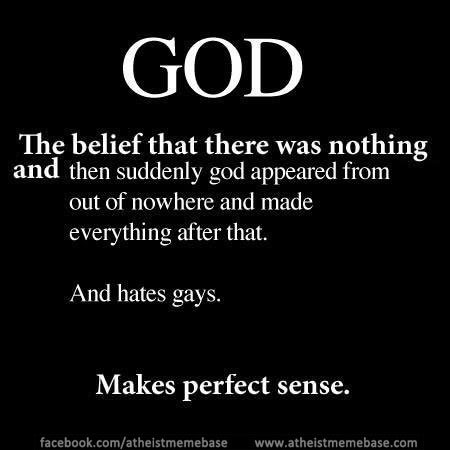
The irony of this meme is obvious once you begin to assess the wording and apply the same standard to atheism. If you replace ‘god’ with ‘the universe’ in this meme you’ll have the following sentence…. “The belief that there was nothing and then suddenly the universe appeared out of nowhere and that made everything after that.” This sentence is precisely what atheists are required to believe to loyally adhere to atheism. Atheism and materialism are bedfellows that strictly prohibit anything from being explained outside of material causes. So, does the universe popping into existence out of nothing make ‘perfect sense’? Not to me and not to most people. There have been no scientific observations made that support the claim that material has the power to cause its own existence.
This meme also makes a false presupposition from the get-go; it assumes that God began to exist and then subsequently created everything. The very nature of God is an eternal being without a beginning. The notion of a finite god doesn’t meet the definition of God. If there is a God, the existence of the universe and everything within it would be contingent upon Him, the Creator.
The last statement, “and hates gays” is just ridiculous. This is the poorly articulated ridicule that shuts down substantive dialogue.
2.
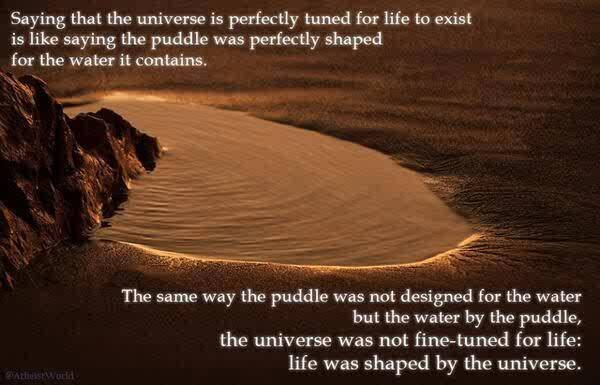
The author of this meme is attempting to claim that fine-tuning doesn’t exist by attempting to make a parallel between the elements of fine-tuning observed in our universe and water forming to the shape of the pond. However, does this seemingly clever little parallel hold water? The answer is no. As much as the author wants to attribute all of the fine-tuning for the existence of habitable universe and intelligent life-forms to mere physical necessity (i.e. it couldn’t have been any other way), the reality is that the universe could be much different. In fact, the existence of the universe being uninhabitable is incomprehensively greater than observing a universe that is habitable for intelligent life.
Below is a video that effectively describes the fine-tuning argument:
http://www.youtube.com/watch?v=UpIiIaC4kRA
After viewing the video, the analogy used in the meme falls apart. The universe couldn’t ‘shape’ life if the constants and quantities weren’t precisely tuned to allow for living organisms to exist. Given the vast number of constants and quantities that had to fall within a very narrow life-permitting range, the likelihood of chance or physical necessity being the most probable explanation is nearly impossible.
3.

To dismiss the entire idea of intelligent design on the basis of perceived natural flaws is like saying that Disney World is a product of random chance because Splash Mountain was closed due to mechanical difficulties. There are lots of examples that illustrate the absurdity of this meme’s message. Are vehicles not designed when it is discovered they have engineering flaws? Are paintings not painted by artists when imperfections are discovered? Are books without authors if a letter is misspelled? Reality evidences the fact that designs do not require perfection in order to be designed. This meme is about as evidentially valid as saying that Mt. Rushmore was the product of wind and erosion.
4.
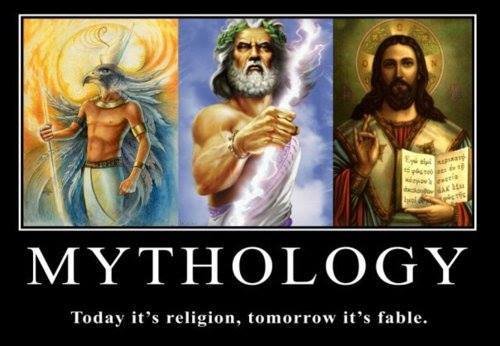
I’m assuming the intention of the meme is to compare Jesus to other mythological gods by assuming that Jesus was developed on a fictitious basis and was eventually deified on a global scale. Unlike Zeus and his band of mythological brothers, the historical narrative of Jesus is firmly rooted in historical evidence. What the meme conveniently fails to mention is the fact that a persuasive historical case can be made for the resurrection of Christ. On the whole, the vast majority of modern New Testament scholarship (including popular Biblical scholar and skeptic Bart Erhman) openly accepts that Jesus was a historical individual and that his life and ministry was chronicled reliably. While not all New Testament scholars accept the resurrection as a historical reality, they concede that much can be known about the historical Jesus because of the abundant amount of reliable sources about his life and ministry. The historical evidence is what separates Jesus from any figure of mythology.
5.
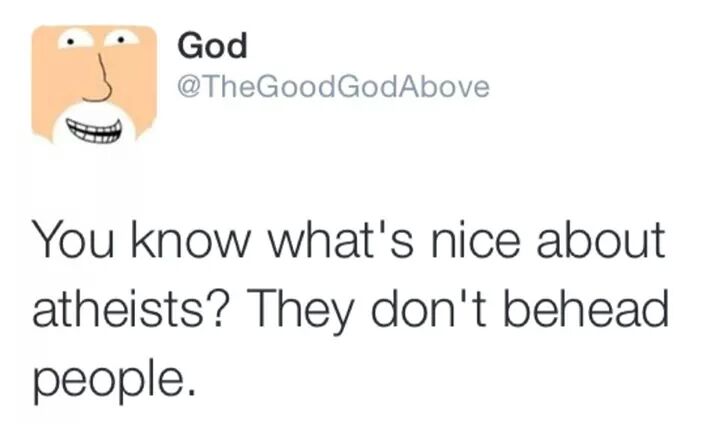
The “God” page has almost two million ‘likes’ on Facebook. Wow… In brief summary, this page is a mockery of the Biblical God. If one were to skim through the page, it would soon be clear that the page is designed to invoke humor at God’s expense. While the humor may be lighthearted at times, I’ve observed posts that are directly pointed at God/theists in a negative way; like the picture above.
When I see comments like this, I ask myself a couple different questions. 1) Are you familiar with 20th century history? And 2) How can you make an objective moral judgment without the existence of a transcendent moral standard that can only be provided by a moral law giver? In the video below, Ravi Zacharias beautifully answers both of these questions together…
http://www.youtube.com/watch?v=0218GkAGbnU
After viewing this short video addressing these questions, does the meme have the same rhetorical impact? Clearly not. Regardless of which method one chooses to murder, atheistic dictatorships have been responsible for more killing in the 20th century than the total amount of deaths from all religious actions combined. It was Fyodor Dostoyevsky who said, “If God is not, everything is permitted.” When these atheistic dictators loyally adhered to their worldviews, history has proven that atheism is a much more dangerous worldview due to the lack of objective moral prohibitions.
It may be considered trendy to make these types of comments when ISIS beheadings are frequently happening in the Middle East in an attempt to portray atheism as being morally superior. This attempt at moral superiority is vain. Trying to portray the atheistic worldview in a morally superior light isn’t supported by historical evidence or philosophical reasoning.
Conclusion
My goal with this post is to challenge people to think beyond the common meme arguments that are used by many internet infidels online. I cannot comprehend why anyone would advance an argument through a meme but since they are becoming increasingly prevalent in social media, I felt it was worth a post to address the more common memes I’ve seen.
I know atheists are not the only guilty parties in the war of the memes on social media. I discourage all Christians from posting fallacious memes that advance poorly articulated thoughts and arguments. This is not a way to advance the Word. As we’ve seen above, simply because it may sound clever on the surface doesn’t mean that it’s a good argument for your position.
Lastly, if you can’t help yourself…post a cute meme of a puppy or something. Everyone loves puppies.