Tag: Richard Dawkins

  • The Heavy Indictment Against God’s Righteousness

    The Heavy Indictment Against God’s Righteousness

    Many people have emotionally and intellectually wrestled with the evils and sufferings of this world. Everyone, Christian and atheist alike, genuinely wonder about the reasons for the existence of these evils and sufferings. When evil and suffering is as prevalent as it is, it is a natural curiosity for anyone of any background to contemplate these things. Worldviews (i.e. Christianity, Islam, Judaism, Buddhism, Hinduism, Atheism, etc…) approach the matter of earthly evil and suffering in different manners, some more effective than others. However, Christianity stakes a claim that no other religion does. God condescended himself into the form of man and experienced evil and suffering from a first hand human perspective while simultaneously remaining fully God. In the process of Jesus’ earthly ministry, God opened the door for everyone to experience eternity without evil in His divine presence through His everlasting sacrificial act of drying on the cross and resurrecting on the third day. All that is required is to accept Jesus Christ as Lord and Savior in order to inherit eternal life with Him through His grace.

    After watching the video of Stephen Fry, you’ll probably get a different impression of the Christian God than the one I very briefly described above. Fry and I approach this matter from two very different perspectives; I know Fry isn’t the only individual who feels this way about the Christian God. Among the unbelieving community, many are discontented by the very same perception of God. In their mind, the Christian God is a seemingly evil one. As Fry states during this video,

    “…the god who created this universe, if indeed it was created by God, is quite clearly a maniac. Utter maniac. Totally selfish. Totally. We have to spend our life on our knees, thanking him? What kind of god would do that? Yes, the world is splendid, but it also has in it insects, whose whole life cycle is to burrow into the eyes of children and make them blind. That eat outwards from the eyes. How — why? Why did you do that to us? You could easily have made a creation in which that didn’t exist. It is simply not acceptable…It’s perfectly apparent that he’s monstrous, utterly monstrous, and deserves no respect whatsoever. The moment you banish him, your life becomes simpler, purer, cleaner and more worth living in my opinion”

    Fry isn’t the only atheist who’s expressed his passionate discontent with the Christian God. Richard Dawkins famously wrote the following in his book, The God Delusion,

    “The God of the Old Testament is arguably the most unpleasant character in all fiction: jealous and proud of it; a petty, unjust, unforgiving control-freak; a vindictive, bloodthirsty ethnic cleanser; a misogynistic, homophobic, racist, infanticidal, genocidal, filicidal, pestilential, megalomaniacal, sadomasochistic, capriciously malevolent bully.”

    I could continue to list quotes from the New Atheists concerning their feelings on how seemingly evil Christian God but I’ll spare you the extra reading. The main point being made by these unbelievers is that the Christian God is evil (if He exists) because of the fallen condition of the world. Is there an adequately satisfying answer to this difficult concern? Does Fry point out anything in the video that would substantively add anything to this conversation? Is atheism a more satisfying approach to the problem of suffering and evil? Since Fry clearly considers Christian theism to be a worldview that miserably fails to account for the fallen condition of this world, it’s important to assess whether his own worldview accounts for this problem any better. If it doesn’t, would Fry be as outraged about atheism as he was at God during this video?

    Is God a Bad Guy?

    If I understand Fry correctly, God is an “utter maniac” because of the perceived injustices that are observed in the form of natural evil (i.e. tornados, hurricanes, disease, etc…) and moral evil (i.e. evil freely performed at the hand of moral agents), but is this a sound inference? Can it be firmly established that God is a bad guy because he permits certain evils to occur on Earth while undoubtedly having the power to stop them? Respectfully, I found Fry’s response to be grossly presumptuous and arrogant. I don’t make this comment as an ad hominem attack to Fry’s character because he’s very cleverly spoken (similar to Christopher Hitchens), but he has a grossly inflated sense of his own understanding of God. While Fry sincerely believes he was accurately presenting the qualities of the Christian God, his critique couldn’t have been a more misrepresentative description of the way God truly is.

    Fry’s indictment of God being a perverse selfish monster is ultimately without solid foundation under an atheistic worldview. Those who are committed to an atheistic worldview, such as Fry, find themselves without an absolute standard to morally judge the God they’re denouncing. Fry’s moral denouncement of God must be supported by an objective standard of morality if it is to have meaning. For Fry to insinuate that God is morally despicable would be comparable to me calling a foul in a game without rules. This point can be made persuasively through the moral argument. As Frank Turek says, “atheists have to sit on God’s lap to slap his face”.

    Given Fry has made his grievances against God clearly known, should he be satisfied with how the atheistic worldview addresses suffering and the existence of evil. Obviously, there wouldn’t be a God to point at and scold for being the cause of all perceived variations of evil. Under atheism, God cannot be blamed for any evil or suffering because God would not be a reality. A committed atheist must chalk all of these perceived natural injustices to a uniform state of amorality. The adjective ‘selfish’ would not have any objective moral meaning while using it to describe someone’s behavior because it is an adjective that describes a moral quality.

    Something that is more depressing is that atheism provides no hope for anyone. No ultimate justice will be issued to anyone for any wrongdoing. Hitler, Stalin, and Mao, the mass murdering dictators of the 20th century, will not receive ultimate justice for their murderous actions in the same way that Mother Teresa will not be rewarded for her love of Christ and her life she devoutly dedicated to serving the less fortunate in His name. Atheism’s hopeless reality doesn’t mean that it’s false but it does reveal that Fry’s comments directed at God are ultimately meaningless if his atheism is true. There is a philosophical contradiction in the way Fry believes the world ought to be and the logical implications of his own atheistic worldview. Atheism doesn’t permit absolute morality but Fry freely issues moral denouncements of God as though an absolute standard of morality actually exists. If Fry desires justice, atheism is the wrong worldview to ultimately attain it.

    Christianity offers a framework that best explains the existence of suffering and evil. Fry’s descriptions of God are grossly misinformed, but they seem to be an inference he’s sincerely made based upon his perception of evil and injustice he’s observed in the world. Outside of the philosophical inconsistencies between his worldview and his moral assessment of God, Fry has not persuasively demonstrated that the existence of evil and the existence of God are incompatible. Other than Fry’s strongly worded demeaning of God aimed at explaining why he thinks a good God wouldn’t permit such evils to occur, his explanation of “You [God] could easily have made a creation in which that didn’t exist” still fails to justify why God and evil cannot exist simultaneously without contradiction.

    God has made us in His image, which has given us the personal ability to make free choices. This is a mechanism imbedded within humanity that permits people to freely conduct themselves in an evil (or righteous) way, which has subsequently resulted in many of the world’s most incomprehensible evils. Our God loves us enough to let us make our own free decisions. Anytime you give someone the opportunity to make their own free choices, the possibility always exists that the wrong choice will be made. The nature of freewill allows for a wide range of results, from absolute evil to absolute love. That’s why much of the evil we observe is at the hand of people freely acting in evil ways. When we complain that God allows too much evil throughout history, are we saying that we would prefer God to intervene anytime evil is about to be performed in order to live in a world without evil? The fact is that God would constantly be intervening in our lives because we constantly sin. Every day that we live (unless we are in a coma) we sin. Should God forcefully remove our freewill to keep up from voluntarily sinning in every instance where evil will be the result of our actions? If so, freewill will have been revoked and we are no longer free to make choices on our own.

    While it’s hard to comprehend the reason why God would permit such seemingly gratuitous evil and suffering, especially over the last century, God is the only being capable of knowing the end result for every action ever taken within His creation. Yes, these free actions performed by Hitler, Stalin, Mao, etc… were evil, but God had moral justification for permitting such an evil. Given God’s divine omniscience, He would be able to see the ultimate good that would arise out of those evil actions. It’s incomprehensible for us to fully wrap our minds around, and many unbelievers still default to the ‘a good God would never allow such events to happen’ approach without providing justification for their reasoning because they cannot reconcile this issue in their own minds. Ultimately, it will likely always remain a mystery why certain evils are permitted to occur but we can confidently infer that God is an all-just God through the evidence provided by natural and special revelation.

    Do Parasites Discredit the Benevolent Character of God?

    Fry is quite presumptuous when he talks about how God failed in his creation (“if indeed it was created by God”.) As a fallible being that exists in a minutely small window of temporal time, how can one deliver a reliable critique about the perceived imperfections of nature? Does Fry presume to know the ultimate meaning and purpose of all creation? Ultimately, if one doesn’t know the purpose of the design, how can one effectively measure whether nature is performing optimally? Fry cites the Loa Loa African Eye worm that burrows “into the eyes of children and make them blind” as an explicit example of one of God’s evil creations. This parasitic creature is one of many in the parasite family, but does the existence of parasitic creatures illustrate the monstrous nature of God’s character? Absolutely not.

    As it turns out, parasites serve a valuable purpose in nature despite what Fry would have you believe. While parasites may not be pleasant to think about, many have a valuable function. Parasites can regulate species population, stabilize the food chain, feed on decomposing flesh, and bolster immunity is certain cases (source). While some parasites may be more beneficial than others, claiming that parasitic creatures are the concoction of an evil God is scientifically and philosophically misinformed. Fry must support the claim that parasites are inherently the production of an evil God. If he cannot justify this hefty claim, especially after seeing the scientific evidence for the value of parasites within nature, his accusation that God is evil because of perceived evils found within creation falls embarrassingly short of his target.

    Should We Thank God?

    In the context of talking about how much evil and suffering exists in the world, Fry asks, “We have to spend our life on our knees, thanking him? What kind of god would do that?” The Christian God, creator of Heaven and Earth, redeemer of all sins, requires that we believe in Him in order to inherit eternal life in His presence. God, by definition, is the only being worthy of worship. Looking at God from the holistic perspective that I’ve laid out above (any many other places on this blog), it can be confidently inferred that God is genuinely worthy of worship (and thanks!) Should we be thankful for our existence? Yes. Should we be thankful for the opportunity to freely choose to accept Christ? Absolutely. God has given us the opportunity to not only accept Him, but reject Him if we so choose. Fry has made His choice to freely reject God, sadly however, he’s rejecting a God that he’s largely imagined on his own. God, honestly and accurately defined, warrants our gratuitous thanks and love.

    Conclusion

    Most generally, I wouldn’t respond directly to a comment made by a hostile atheist. However I find that this is an issue that disturbs a ton of people in the unbelieving community (and many within the Church) and it is truly worthy of further exploration and serious thought. Not simply to address Fry but to address those with the same types of qualms and concerns. This is an objection that has been around for centuries and it is not going to vanish anytime in the foreseeable future. Given this fact, Christians should become familiar with the objection and learn how to respond to it with intellectual integrity.

    In the end, sadly, we’re largely left in ignorance as to why certain evils are permitted. However this fact does not justify the claim that God is evil or nonexistent altogether. To hatefully speak against God, in the way Fry has, is to deem oneself more superior in knowledge than an incomprehensibly omniscient God, who has an exhaustive knowledge of the past, present, and future. While I still wonder about why the Holocaust was permitted, I can rest assured knowing that if God permitted it to happen; He would be in an infinitely better position to know what the moral justification was for it than I would.

    This indictment against God’s righteousness that many unbelievers have irresponsibly made is ultimately futile. Moral good or bad cannot exist without a God, which would make all moral denouncements of God’s character impotent. If God does exist and these inferences are still being held to, then the basis for their description of God is sadly misinformed. In the end, the indictment fails and God’s righteousness remains solidly intact.


  • How Reasonable was the Reason Rally?

    How Reasonable was the Reason Rally?

    While I was not present at the 2012 Reason Rally, I heard many interesting stories about the rally, particularly about the main event. The headliner of the event was Mr. New Atheist himself, Dr. Richard Dawkins (author of The God Delusion). While there were many activities during the rally, many people remember the rally based on the speech (video above) delivered by Dawkins. As far as I can tell, Dawkins’ speech was the most memorable during the rally and embodied the soul of what the event was truly about. It makes sense. He’s the icon of modern atheism. Dawkins assures atheists that they can confidently be the ‘brights’ among a see of intellectual depravity.

    My concern about the Reason Rally is simple; is it compatible with reason? Many in the unbelieving community wave the flag of reason and allege to pray at the altar of science but is it reasonable to believe that atheism is sitting on a firm foundation that can withstand the weight of such claims. As Frank Turek brilliantly describes in his new book Stealing from God: Why Atheists Need God to Make their Case, that atheists cannot make their case for atheism without stealing qualities about reality that wouldn’t have existed without God. Essentially, they need God to fight against Him. With this premise in mind, how can atheists promote a rally that alleges to celebrate the reasonability of atheism when reason wouldn’t have existed in a universe without the existence of a God?

    It’s clear that the atheists fail to understand the philosophical implications of their worldview. They’ve developed their own Ten Commandments for the 21st Century without acknowledging that the very commandments that they’ve development are without ontological foundation (review article here). Atheists belligerently complain about the mean ol’ Old Testament God without realizing that all moral actions of any kind are completely subjective and physically determined (review article here). Is the same thing going on with the Reason Rally? Are they claiming that they’re advocates of reason when they’ve misinterpreted the implications of their own worldview in an attempt to smuggle in reason? Given their philosophical track record, it seems that the only thing they’re consistent at is being inconsistent.

    Is Reason Compatible with Atheism?

    Since Dawkins was the main event, it is curious to see how Dawkins defined reason, “Reason means basing your life on evidence and on logic, which is how you deduce the consequences of evidence.” I wholeheartedly agree with his definition. However, does this definition align with all of the implications that atheism brings to the table? There are a couple of really good questions that one must ask if this question is going to be answered properly…

    Does atheism allow for freewill? The answer is no. How can one be reasonable if he or she cannot choose to be reasonable? According to philosophical materialism, which is the dominant philosophical position of most atheists, everything that exists must have a material cause. Nothing is immaterial. This means that philosophical materialism necessarily entails that everything in the universe is determined by a prior material cause that stems all the way back to the first moment of time. All the molecules in our bodies are merely reacting to previous causes without any the interruption of freewill (freewill assumes a mind and a mind is immaterial). Now, if philosophical materialism is true, would we have the ability to be reasonable? The Reason Rally presupposes that we have the ability to freely choose to be reasonable. With that in mind, Dawkins wrote in River Out of Eden: A Darwinian View of Life,

    “In a universe of blind physical forces and genetic replication, some people are going to get hurt, other people are going to get lucky, and you won’t find any rhyme or reason in it, nor any justice. The universe we observe has precisely the properties we should expect if there is, at bottom, no design, no purpose, no evil and no good, nothing but blind, pitiless indifference. . . . DNA neither knows nor cares. DNA just is. And we dance to its music” (p. 133)

    Dawkins’ quote states that we are determined by DNA as we “dance to its music.” I’m not surprised that Dawkins didn’t feel comfortable to share this fact with his audience of adoring fans. If he had, his inspiring go-gettem’ speech wouldn’t have had the same affect. I probably would have ignored that part too. Imagine going to a Reason Rally only to find out that you have no ability to reason if atheism were true. The ability to reason would only be possible if we had the free ability to think and make choices. Given the fact that we don’t question every thought (which would also be impossible under atheism) as being determined by the molecules in our brains reacting together to produce a physical effect, this reality should serve as a helpful commonsense hint that maybe philosophical naturalism is false.

    How would we know what reason is under atheism? It’s impossible. For the reasons listed above, everyone would be physically determined by the laws of physics from the very beginning of time. Similar to a long line of dominos, our actions are merely the product of the previous domino. That is why it is a problem with naming an atheistic gathering a ‘Reason Rally’! Atheism lacks all of the philosophical resources that are necessary for freely recognizing reason. The nature of philosophical materialism is the biggest roadblock for the atheist who wants to affirm objective morality, reason, freewill, or logic. Those atheists that valiantly affirm these qualities about life are living contradictory to the worldview they espouse.

    Reason is immaterial, so why start a Reason Rally advocating materialism? Based on Dawkins’ definition of reason above, the foundation for reason is ‘logic’ and ‘evidence’. Not surprisingly, Dawkins and the atheistic clan of brights are living inconsistently here too. The laws of logic are immaterial! For a philosophical materialist, it’s awfully curious to deduce from ‘logic’ and ‘evidence’ that philosophical materialism is correct by using the immaterial laws of logic. Why would a materialist use an immaterial process to prove immateriality does not exist? These are pitfalls of the philosophical materialist because the reason and logic they celebrate can’t be justified under their worldview. As Frank Turek says, atheists are “stealing from God to make their case!

    Is it Reasonable to Ridicule?

    Much of what came from the Reason Rally was intolerant towards the religious community despite what the Reason Rally declared on their website in their ‘About’ section,

    “Are we just going to use this opportunity to trash religion?
    No. This will be a positive experience, focusing on all non-theists have achieved in the past several years (and beyond) and motivating those in attendance to become more active. While speakers have the right to say what they wish, the event is indeed a celebration of secular values

    The question itself underhandedly implies that they will trash religion, but they clarified this by saying they were not gathering just to trash religion – there would be other stuff too. With that disclaimer being disingenuously outlined on their website, Dawkins made the following statement which became one of the highlights of his speech,

    So when I meet somebody who claims to be religious, my first impulse is: “I don’t believe you. I don’t believe you until you tell me do you really believe — for example, if they say they are Catholic — do you really believe that when a priest blesses a wafer it turns into the body of Christ? Are you seriously telling me you believe that? Are you seriously saying that wine turns into blood?” Mock them! Ridicule them! In public! Don’t fall for the convention that we’re all too polite to talk about religion. Religion is not off the table. Religion is not off limits. Religion makes specific claims about the universe which need to be substantiated and need to be challenged and, if necessary, need to be ridiculed with contempt.”

    This is a peek into the heart of a bitter atheist. Thankfully, most atheists are not like this. Dawkins is a angry old man with a vendetta against religion, particularly Christianity. He is definitely in need of prayer from the Christian community because it’s genuinely sad to see someone so angry and bitter. He’s blinded by this anger. He doesn’t see that he accuses the religious community of intolerance while being an icon of intolerance himself. He is the equivalent of a ‘fundamentalist’ in the atheistic community. Regardless of how philosophically inconsistent the atheistic community lives, I seriously doubt they would want to be represented by a man who is embodies an aggressively militant attitude towards the religious community as a whole. If reason were actually possible under atheism, it’s not reasonable to make the statements Dawkins made at the Reason Rally.

    Conclusion

    Life is meaningless if the atheistic worldview is true. Does that mean atheism is false? Absolutely not, however what can be persuasively shown is that a strong cumulative case for Christian theism does exist. In light of the evidence as a whole, it truly does take more faith to be an atheist than it takes to be a Christian. When those at a Reason Rally say that it’s more reasonable to be a member of the unbelieving community, it’s important to acknowledge the fragile foundation from which they’re making such a claim to intellectual superiority.

    I’d be interested to know how many individuals who attended the Reason Rally acknowledge these philosophical implications as realities associated with their worldview. Oddly enough, even if they did acknowledge any of these philosophical realities, they would have been determined by their genes to acknowledge them without any free choice of their own. I seriously doubt that anyone at the Reason Rally would have freely admitted this fact if they were being honest with themselves. We were designed with the ability to freely choose to make choices of our own and be morally accountable to God for all of our actions. Saying that we’re meat machines merely responding to physical stimuli doesn’t pave a pathway to intellectual advancement. The world only makes sense if we see ourselves as unique individuals with the ability to freely contribute to society while being accountable for our own moral actions. We’ve been made in the image of God and this is the only framework that makes sense of our experience of reason, logic, morality, science, and free choice.

    One may choose to ignore these facts and willfully deny the implications of their chosen worldview, but avoiding these realities does not allow for genuine and honest advancement. Our image as humans reflects the image of God and that’s why we can make sense of the world around us. We can admire a beautiful sunset because we have the ability to recognize the reality of beauty. We can recognize justice when a convicted criminal is sent to prison for brutally murdering an innocent family. We can deduce from ‘logic’ and ‘evidence’ that we are not meaningless through the special and general revelation of God. These are the realities that can be easily acknowledged without strain by the genuine seeker of truth. I’m convinced that is why atheists are so desperate to borrow these realities that Christians freely accept, even if it means that it going against the grain of their own worldview. Their worldview requires the acceptance of many facts that are much too burdensome to bear. As Christians, it’s important that we point out these facts and ask them that if they are incapable of living the life of an honest atheist, why not live a worldview that makes sense of all of the facts? Jesus Christ provides a worldview that easily provides all of the resources to make sense of reality and gives us the freedom to live a life connected to the One who created it all. Instead of running from the Creator, embrace Him. Christ is our reason to rally!

  • The Atheistic Critique of the Old Testament Genocidal God

    The Atheistic Critique of the Old Testament Genocidal God

    Over the last decade or so, many outspoken atheists have strongly expressed their resentment for the Old Testament God. They condemn Him as a Being they wouldn’t want to worship even if they could be convinced of His existence because of the ‘moral atrocities’ He has brought upon groups of people throughout history. Many of their complaints revolve around the Mosaic Laws and the destruction of the Canaanites because they perceive these laws and actions as being evil, genocidal, misogynistic, homophobic, hateful, and the like. In fact, all of the New Atheists have been very deliberate in their expression of disgust towards the Old Testament God. Richard Dawkins summarizes the New Atheism’s sentiment perfectly when he writes in The God Delusion,

    The God of the Old Testament is arguably the most unpleasant character in all fiction: jealous and proud of it; a petty, unjust, unforgiving control-freak; a vindictive, bloodthirsty ethnic cleanser; a misogynistic, homophobic, racist, infanticidal, genocidal, filicidal, pestilential, megalomaniacal, sadomasochistic, capriciously malevolent bully

    The late Christopher Hitchens remarked on the Old Testament God when he wrote God is Not Great,

    The Bible may, indeed does, contain a warrant for trafficking in humans, for ethnic cleansing, for slavery, for bride-price, and for indiscriminate massacre, but we are not bound by any of it because it was put together by crude, uncultured human mammals

    Daniel Dennett writes in Breaking the Spell: Religion as a Phenomenon,

    Part of what makes Jehovah such a fascinating participant in stories of the Old Testament is His kinglike jealousy and pride, and His great appetite for praise and sacrifices

    Lastly, Sam Harris writes the following in Letter to a Christian Nation while attempting to use (‘misuse’ is a better description) Deuteronomy 13:7-11 to support his claim that stoning is what “God had in mind”,

    One look at the book of Deuteronomy reveals that he [God] has something very specific in mind [stoning] should your son or daughter return from yoga class advocating the worship of Krishna

    All of the New Atheists have gratuitously commented on their dissatisfaction with the Old Testament. If someone had nothing to go on other than the mere opinion of one of these embarrassingly confused atheists, it would be easy to see how someone could become convinced. After all, they are all brilliant wordsmiths who make a convincing case for their position on paper. It’s pretty easy to see why many youngsters who aren’t prepared to tackle these challenges become influenced by the rhetorical power of these scholars. However, as Oxford mathematician and philosopher John Lennox brilliantly observes, “Nonsense remains nonsense, even when talked by world-famous scientists.”

    Does Atheism Provide an Objective Moral Foundation for Judging the Old Testament God?

    Recently an atheistic group wrote their own 10 Commandments for the 21st century, which I wrote a post about because of the remarkable philosophical inconsistencies between atheism and objective morality. The sole message of the article was to express how incoherent such a project would be if the atheistic worldview is true. The same principle can be applied to their complaints about the morality of the Old Testament. An objective moral framework for moral values and duties would not exist, so how can an atheist deliver an objective moral criticism of God when a transcendent standard of morality does not exist? Richard Dawkins concedes this point in River Out of Eden: A Darwinian View of Life,

    “In a universe of blind physical forces and genetic replication, some people are going to get hurt, other people are going to get lucky, and you won’t find any rhyme or reason in it, nor any justice. The universe we observe has precisely the properties we should expect if there is, at bottom, no design, no purpose, no evil and no good, nothing but blind, pitiless indifference. . . . DNA neither knows nor cares. DNA just is. And we dance to its music”

    This quote seems contradictory to the quote above where he hurls a slew of insults at God for allegedly being ‘immoral’. If there truly is “at bottom, no design, no purpose, no evil and no good, nothing but blind, pitiless indifference”, how could Dawkins ontologically justify any of his moral critiques on God? This is the biggest philosophical inconsistency that I see among all atheists. If we are in a “universe of blind physical forces and genetic replication”, determinism is the only game in town and we have to accept that morality of any kind is completely nonexistent and all perceptions of morality are merely determined by our own chemistry and the product of all preceding events leading up to the present moment, similar to dominos falling. Morality would be completely illusory, which would totally invalidate any derogatory moral claims against the Old Testament God.

    Next, atheists commonly complain about why God doesn’t intervene in His creation more frequently and stop the evil in this world if He exists. Ironically, these are the same atheists who fail to recognize that God has intervened in the past and brought judgment upon those who were evil (i.e. the Canaanites), which is the divine intervention that they’re alleging is genocide. Assuming that objectively morality could be grounded on an atheistic worldview, how could an atheist explain away this inconsistency in their argument? Do they want God to act within nature to occasionally judge evildoers (like the case with the Canaanites) or do they want to complain about God acting within nature to judge evil? Atheists are giving mixed messages on this issue.

    Conclusion

    With all the misinformed ranting and raving from the atheists about the Old Testament God, it seems to be all for nothing if atheism is true. Philosophical materialism prevents us from having the freewill to make any free choices of our own. We would be determined by all the preceding material events before us. However, no reasonable person would believe this based upon their own rational experience. Nobody has a thought and comes to the conclusion, ‘I didn’t freely think that thought. The molecules in my head determined me to have that thought.’ This is a counterintuitive way of thinking, but it is philosophically consistent with the atheistic worldview.

    If we were to be charitable and be willing to dismiss the reality of philosophical materialism under an atheistic worldview, we can say with certainty that there would be no ontological basis for objective morality on an atheistic worldview. What does that mean? That means when Dawkins, Hitchens, Dennett, and Harris make their moral judgments of the Old Testament God, their judgments are nothing more than subjective moral complains that express their mere moral preferences. Some people like chocolate ice cream and some people like vanilla. It’s the same thing. Dawkins may think that the Old Testament God is bad while some people may think He is good but without an objective basis to measure moral actions, each person’s moral judgments are completely and utterly subjective.

    Lastly, it seems like those making the moral judgments are failing to recognize the implications of their own worldview. Atheism does not allow for objective moral denouncements. Subjective moral denouncements are possible but determined by all preceding material events. At the end of the day, we all affirm (or want to at least) that our moral judgments are objective. A normal person (without cognitive defect) does not believe that torturing newborns for fun is morally good. Nobody would affirm that statement. However, atheism does not give you the ontological grounding to affirm that denouncement of torturing newborn babies. Christian theism has the resources to objectively support such a denouncement without any difficulty. Since it can be persuasively shown that moral proclamations are impossible in the absence of God, the atheistic moral critique of the Old Testament God falls drastically short of its intended target.

    Below is a debate on the topic of morality between Christian philosopher William Lane Craig and atheist neuroscientist Sam Harris. I would highly encourage everyone to watch this debate who is interested in the topic of morality.

  • The Fight for the Right to Life

    I remember watching the Democratic National Convention (DNC) in 2012 when the then-President of the NARAL Pro-Choice America, Nancy Keenan, gave a short speech (below) endorsing President Obama for reelection because she believes Obama is “a president who believes in a woman’s right to make her own decisions.” Keenan enthusiastically insists that “women in America cannot trust Mitt Romney…and we cannot trust Mitt Romney to respect our rights” while trying to convince her audience that Romney would “overturn Roe v. Wade and sign into law a wave of outrageous restrictions on a woman’s ability to make decisions about her pregnancy. Mitt Romney would take away our power to make decisions about our lives and our futures.” As President of NARAL Pro-Choice America, she would be in an ideal position to authoritatively declare that “the Democratic Party believes that women have the right to choose a safe, legal abortion with dignity and privacy.” Keenan received a glowing response from the hippy-dippy crowd but I was saddened by how precious little these people cared about intellectual substance and integrity rather than about rhetoric and wasteful political posturing. 

    There are many reasons pro-choice people use to justify the intentional ending of an unborn human life. After hearing Nancy Keenan, I wanted to explore what the NARAL Pro-Choice America specifically states about abortion and a possible philosophical and/or scientific justification for taking an unborn human life, or even if they took the time to clearly define a human life in the philosophical or scientific sense in order to validate or elaborate on their position from a moral perspective. It did not take long before I found what they have defined as ‘The Problem’ and ‘The Solution’. They defined ‘The Problem’ as “Anti-choice people want to outlaw abortion, regardless of the woman’s situation. They will stop at nothing to make it harder for women to access abortion. They even target the doctors who provide abortion care.” They define ‘The Solution’ as “We will always have to fight to keep abortion safe and legal. This means defeating attacks in Congress and in the states. We also believe in reducing the need for abortion. This means we support improving access to birth control and teaching young people comprehensive sex education.”

    The NARAL Pro-Choice America pointedly identified their objective as fighting “anti-choice people” but they provided an embarrassingly inadequate explanation as to why they endorse the act of abortion. Under “The Problem” category, they accused ‘anti-choice’ people of passing legislation that would make it harder for abortions to be conducted, setting up crisis pregnancy centers, and the spreading scientific ‘misinformation’ about how abortions do not cause mental illness and breast cancer. This is the sad sum of their justification for abortion, and this is the same pro-choice organization that the DNC elected to represent their entire political party during the 2012 convention to be their pro-choice voice.

    The sad irony is never lost on me when I hear their grievances about how their ‘rights’ are being violated and their ‘choices’ are being undermined by the ‘anti-choice people’ while simultaneously promoting the termination of rights and choices of millions of innocent unborn human lives. I’d support their objective if their goal didn’t inherently require the termination of an innocent human’s God-given right to life. This is the real question at hand; why do pro-choice organizations, like NARAL Pro-Choice America, assume that the unborn human does not have the right to life?

    The SLED Acronym

    There are so many helpful resources that can help assist in better understanding pro-life (or ‘anti-choice’ depending on one’s perspective) matters. In my quest for understanding, I found none to be more influential than Scott Klusendorf of Life Training Institute. He has taught me and thousands of others a practical acronym for memorizing how to construct the strongest pro-life case possible along with using the acronym to respond to potential pro-choice objections to the pro-life case while establishing the fact that the unborn are indeed human and they are as intrinsically valuable as the humans who have already been born. The acronym is SLED and I’ve laid it out below:

    Size – From a tiny embryo to 9 months to a toddler to an adult, does size really matter? Most NBA players are larger than the average human; does that mean that they’re more valuable? Clearly, size does not play a role in how we value humanity. Given this fact, size should not play a role when assessing the value of an unborn human in virtue of being small in size.

    Level of development – Again, from the earliest stages of development to 9 months to a toddler and beyond, does the level of development really matter? My level of development is much more advanced than that of my children. Is my human value greater than the human value of my children because I’m further developed than they are? What about those who are developmentally challenged or disabled, such as individuals who suffer from Alzheimer’s disease or Down’s syndrome? Just as in these  previous examples, neither should an arbitrary standard of value be set for the unborn because they are not advanced insofar as their development is concerned.

    Environment – Does your geographical location determine your value? Am I more valuable when I’m sitting on my recliner at home or at my desk in my office? In the same way, does the unborn human lack value in virtue of being located within the womb of its mother? Does an unborn baby suddenly gain human value by making the trip down the birth canal? These examples clearly illustrate the environment is not what endows value upon any human.

    Degree of Dependency – Is a person on life support without human value because he’s entirely dependent on medical devices for his life? What about someone who’s dependent on insulin or dialysis to remain alive? Like these examples illustrate, the unborn life that’s dependent on the mother for survival is as valuable as a human who is not dependent on anyone or anything for sustained life.

    The Pro-Choice Talking Points

    It’s important to see if any of the primary reasons cited for the justification of an abortion are persuasive and legitimate if one is going to be an objective and critical thinker. There are five reasons that are typically cited among the pro-choice crowd that I’ll address in detail below:

    Rape – Assume someone kidnapped your daughter (assuming you have one), raped her, and forced her to have his child. After delivering the baby, she and the baby escaped from the kidnapper. Would anyone suggest that she kill the baby because it was conceived in rape? No. Why? You wouldn’t kill a human baby. The baby is not morally responsible for the despicable actions of his rapist father. With the same mindset, what justification is there for killing the unborn human child because of the evil actions of the rapist father? After all, if unborn life is human with the same intrinsic value as humans who have already been born, why would killing an unborn human be justified regardless of how the unborn child was conceived? Also, who wins when one fights evil with evil? A more logical approach would be to bring justice to the rapist father rather than kill the innocent human life which resulted from the evil act of the wrongdoer.

    Economic – I have children of my own and they are tremendously expensive. From my own life experience, most parents do not seriously entertain the notion of killing their children because they’re expensive. While it may sound like I’m trivializing their economic concerns, the tragic fact is that people legitimately abort unborn babies because of economic reasons. If you were to kill your three year old child because you couldn’t pay the bills, you would be thrown in jail for the rest of your life or rightfully suffer the death penalty. However, if you abort your unborn child because of the same economic concerns it is perfectly legal. This is a huge philosophical contradiction when the government legalizes the killing of an unborn child in one instance but it considers it illegal under the same circumstance once the child is out of the womb.

    Disability – On a recent podcast of ‘Unbelievable?’, pro-life advocate James Mumford and pro-choice advocate Ann Furedi debated the topic ‘abortion and disability’, which was largely fueled by the following Tweet by Richard Dawkins…

    Dawkins Abortion Tweet

    In basic summary, Mumford rightly outlined that the deformity and/or disability of any unborn child is not what determines the worth of the child and its right to life while Furedi argued that a woman’s personal choice supersedes the right to life of the unborn child regardless of the circumstance because the unborn child is being housed within the mother (more on personal autonomy below). For Dawkins and people that hold the same view who easily disregard the value of a disabled unborn child in virtue of it being disabled are overlooking the fact that they do not extend the same logic to disabled people who have already been born. Mumford correctly points out that medical testing that has been developed to detect spina bifida or Down’s syndrome is ‘prejudicial towards disabled people’ because it was designed for the sole purpose of identifying a specific group of people for execution because of a certain physical attributes. These physical attributes of unborn children, while defective in nature, do not remove the humanity from the unborn baby, thus providing no legitimate justification for an abortion.

    Convenience – The raw reality is that there are certain types of inconveniences associated with parenthood. You can’t freely go on vacations to every destination, go on a relaxing date with your spouse without finding a sitter, put the kids to bed without them suddenly feeling thirsty for an hour and a half, sleep in without hearing breaking noises coming from the kitchen, etc… Imagine if I told my children that I don’t want them any longer because of these inconveniences and now I’m going to send them on a one-way trip to ‘meet Jesus.’ I hope my parody of this pro-choice excuse illustrates how nonsensical it really is.

    Personal autonomy – I fully support personal autonomy to make one’s own choices however abortion isn’t a choice that only affects one’s own person autonomy. It affects the equal autonomy of two separate individuals. For example, if you found out that your neighbor was abusing her toddler within the confines of her own home, would her argument of personal autonomy validly apply because she has the right to make the personal private autonomous decision to abuse her own child? No, choices that vitally affect the rights of others are no longer entitled to autonomy or privacy.

    Conclusion

    Organizations that advance the pro-choice agenda, such as NARAL Pro-Choice America and the Democratic Party, which was defined by the NARAL Pro-Choice America as being the political party that supports “the right to choose a safe, legal abortion with dignity and privacy,” grossly obstruct and mislead the culture’s perception of the way life, unborn and born, is valued. Politics, particularly the far Left of the Democratic Party, has played a large role in the desensitization of abortion’s evil reality. So many pro-choice advocates feel shielded by their easy pro-choice bumper sticker arguments that hide them from the gruesome reality of what abortion really is. Below is a video (WARNING: GRAPHIC CONTENT) that shows footage of abortions that many people have never seen or want to live in ignorance of….

    Do you think if Nancy Keenan played this video prior to her speech at the DNC in 2012 she would have received such an enthusiastic embrace from those in attendance? Maybe she would…but maybe wouldn’t have. The sad reality is that many people are in the dark about the grim reality of what abortion really is. It is a killing of a human life, which is vividly illustrated in this video.

    God has gifted every human, born and unborn, with life. God choose humans to bear His image (Genesis 1:27). Jesus was born as a baby and lived the life of a simple carpenter for a period of time. We’re called not to murderously take the life of another (Exodus 20:13) and to love our neighbors as ourselves (Mark 12:31). As Christians, we need to be capable of intelligibly articulating the cogent case for life. While many people have done their part in helping persuade individuals of the pro-life case, much work still needs to be done. If this work had started earlier with greater fervor among a larger group of people maybe we could have mitigated the amount of tragic deaths among the unborn. To date in America, there have been over 57,000,000 abortions since Roe vs. Wade in 1973. To put that in perspective, that is the combined total populations of the west coast states of California, Nevada, Arizona, Idaho, Oregon, and Washington. Use these facts to fuel your desire to help save an unborn child. Most of all, pray for the unborn and born lives of the past, present, and future that may encounter this tragic situation and that Christians can be their voice in this fight for the right to life.

  • The Failure of the Atheistic Meme

    The Failure of the Atheistic Meme

    Social media has become a breeding ground for memes that address pop culture, politics, religious, etc… I’m exposed to a ton of religiously motivated memes from both Christian and atheistic camps. Admittedly, I’ve seen some funny ones over the years but I’ve also seen some grossly misleading ones. Christians aren’t innocent of partaking in the spreading of ridiculous memes and I feel they should be held accountable when they spread nonsense via meme over social media. However, I’m devoting this article to addressing some popular atheistic memes that won’t seem to go away. In my opinion, these are memes that are completely undeserving of the recognition they’ve received. I have selected five memes (there are many more) that seem to have gained a lot of traction among popular atheistic social media sites.

    The reason for me addressing this particular topic is because I’ve personally observed skeptics who find these meme-arguments to be top-notch. This type of lazy thinking doesn’t benefit anyone and the tone that it sets is destructive for those who genuinely desire to have a constructive dialogue. Some may think that I’m taking these memes too seriously, and I would be inclined to agree. These memes are undeserving of any serious consideration most of the time. However, what about those who are young in their faith and are not equipped to thoroughly respond to these memes that are written to appear pseudo-sophisticated? It’s important for those that are persuaded by these atheistic meme-arguments and those that truly feel challenged by them to understand that these memes largely fail when attempting to advance arguments that challenge the opposing position. Some people, like myself, take these little memes with a grain of salt but others unfortunately become influenced by them.

    We should let the meme-content speak for itself and not dismiss it because it’s merely a meme; that would be a fallacy. With that being said, let’s give these memes some serious thought and judge them on the basis of their own merits…  

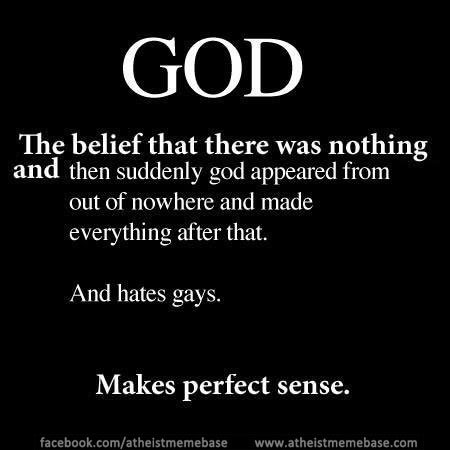
    1.

    Atheist meme 3

    The irony of this meme is obvious once you begin to assess the wording and apply the same standard to atheism. If you replace ‘god’ with ‘the universe’ in this meme you’ll have the following sentence…. “The belief that there was nothing and then suddenly the universe appeared out of nowhere and that made everything after that.” This sentence is precisely what atheists are required to believe to loyally adhere to atheism. Atheism and materialism are bedfellows that strictly prohibit anything from being explained outside of material causes. So, does the universe popping into existence out of nothing make ‘perfect sense’? Not to me and not to most people. There have been no scientific observations made that support the claim that material has the power to cause its own existence.

    This meme also makes a false presupposition from the get-go; it assumes that God began to exist and then subsequently created everything. The very nature of God is an eternal being without a beginning. The notion of a finite god doesn’t meet the definition of God. If there is a God, the existence of the universe and everything within it would be contingent upon Him, the Creator.

    The last statement, “and hates gays” is just ridiculous. This is the poorly articulated ridicule that shuts down substantive dialogue.

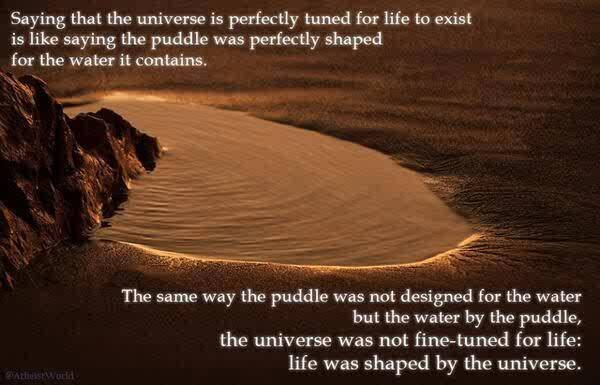
    2.


    Atheist meme 1

    The author of this meme is attempting to claim that fine-tuning doesn’t exist by attempting to make a parallel between the elements of fine-tuning observed in our universe and water forming to the shape of the pond. However, does this seemingly clever little parallel hold water? The answer is no. As much as the author wants to attribute all of the fine-tuning for the existence of habitable universe and intelligent life-forms to mere physical necessity (i.e. it couldn’t have been any other way), the reality is that the universe could be much different. In fact, the existence of the universe being uninhabitable is incomprehensively greater than observing a universe that is habitable for intelligent life.

    Below is a video that effectively describes the fine-tuning argument:

    http://www.youtube.com/watch?v=UpIiIaC4kRA

    After viewing the video, the analogy used in the meme falls apart. The universe couldn’t ‘shape’ life if the constants and quantities weren’t precisely tuned to allow for living organisms to exist. Given the vast number of constants and quantities that had to fall within a very narrow life-permitting range, the likelihood of chance or physical necessity being the most probable explanation is nearly impossible.

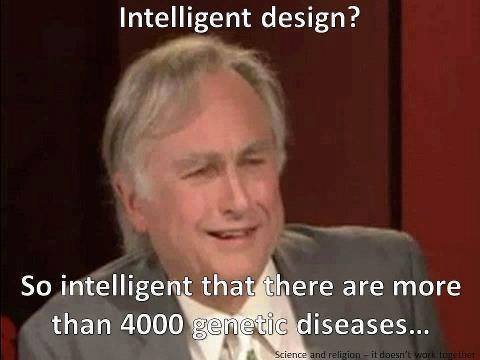
    3.

    Atheist meme 7

    To dismiss the entire idea of intelligent design on the basis of perceived natural flaws is like saying that Disney World is a product of random chance because Splash Mountain was closed due to mechanical difficulties. There are lots of examples that illustrate the absurdity of this meme’s message. Are vehicles not designed when it is discovered they have engineering flaws? Are paintings not painted by artists when imperfections are discovered? Are books without authors if a letter is misspelled? Reality evidences the fact that designs do not require perfection in order to be designed. This meme is about as evidentially valid as saying that Mt. Rushmore was the product of wind and erosion.

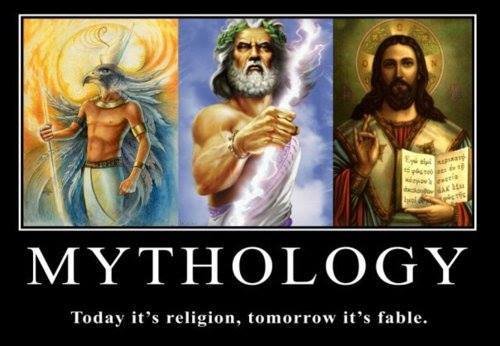
    4.

    Atheist meme 4

    I’m assuming the intention of the meme is to compare Jesus to other mythological gods by assuming that Jesus was developed on a fictitious basis and was eventually deified on a global scale. Unlike Zeus and his band of mythological brothers, the historical narrative of Jesus is firmly rooted in historical evidence. What the meme conveniently fails to mention is the fact that a persuasive historical case can be made for the resurrection of Christ. On the whole, the vast majority of modern New Testament scholarship (including popular Biblical scholar and skeptic Bart Erhman) openly accepts that Jesus was a historical individual and that his life and ministry was chronicled reliably. While not all New Testament scholars accept the resurrection as a historical reality, they concede that much can be known about the historical Jesus because of the abundant amount of reliable sources about his life and ministry. The historical evidence is what separates Jesus from any figure of mythology.

    5.

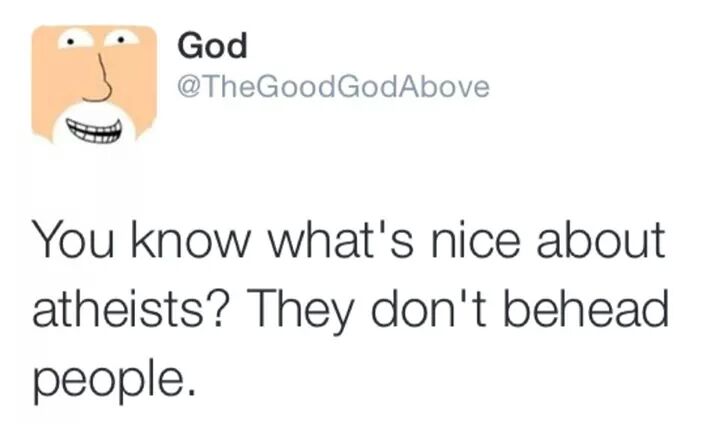
    God beheading me

    The “God” page has almost two million ‘likes’ on Facebook. Wow… In brief summary, this page is a mockery of the Biblical God. If one were to skim through the page, it would soon be clear that the page is designed to invoke humor at God’s expense. While the humor may be lighthearted at times, I’ve observed posts that are directly pointed at God/theists in a negative way; like the picture above.

    When I see comments like this, I ask myself a couple different questions. 1) Are you familiar with 20th century history? And 2) How can you make an objective moral judgment without the existence of a transcendent moral standard that can only be provided by a moral law giver? In the video below, Ravi Zacharias beautifully answers both of these questions together…

    http://www.youtube.com/watch?v=0218GkAGbnU

    After viewing this short video addressing these questions, does the meme have the same rhetorical impact? Clearly not. Regardless of which method one chooses to murder, atheistic dictatorships have been responsible for more killing in the 20th century than the total amount of deaths from all religious actions combined. It was Fyodor Dostoyevsky who said, “If God is not, everything is permitted.” When these atheistic dictators loyally adhered to their worldviews, history has proven that atheism is a much more dangerous worldview due to the lack of objective moral prohibitions.

    It may be considered trendy to make these types of comments when ISIS beheadings are frequently happening in the Middle East in an attempt to portray atheism as being morally superior. This attempt at moral superiority is vain. Trying to portray the atheistic worldview in a morally superior light isn’t supported by historical evidence or philosophical reasoning.

    Conclusion

    My goal with this post is to challenge people to think beyond the common meme arguments that are used by many internet infidels online. I cannot comprehend why anyone would advance an argument through a meme but since they are becoming increasingly prevalent in social media, I felt it was worth a post to address the more common memes I’ve seen.

    I know atheists are not the only guilty parties in the war of the memes on social media. I discourage all Christians from posting fallacious memes that advance poorly articulated thoughts and arguments. This is not a way to advance the Word. As we’ve seen above, simply because it may sound clever on the surface doesn’t mean that it’s a good argument for your position.

    Lastly, if you can’t help yourself…post a cute meme of a puppy or something. Everyone loves puppies.

  • “The Unbelievers” Documentary

    “The Unbelievers” Documentary

    [youtube http://www.youtube.com/watch?v=ZxDLkoK8vQQ&w=560&h=315]
    Biologist Richard Dawkins and theoretical physicist Lawrence Krauss are the stars of the new documentary “The Unbelievers”. Given that these two prominent atheists are the main features of the upcoming documentary, it is likely that it will stir up the atheistic scene as Bill Maher’s “Religulous” did but on a much grander scale. The reason why I believe this movie will have more of an influence is because Dawkins and Krauss disguise their philosophies with the notion that “science rids the possibility of God” while Maher did not really make a substantive point at all. Maher simply tries to make religion looks ridiculous, hence the name of his documentary.

    Before discussing the documentary, I wanted to provide a couple of videos of debates that Richard Dawkins and Lawrence Krauss have been involved in. Below is a debate between Lawrence Krauss and William Lane Craig…

    [youtube http://www.youtube.com/watch?v=9eNjmN9Xtmg&w=560&h=315]

    Below is a debate between Richard Dawkins and John Lennox…

    [youtube http://www.youtube.com/watch?v=VK2OcIIkpPo&w=420&h=315]

    While these videos are quite long, if you are interested in knowing more about the scientific/philosophic/theological stances of Richard Dawkins and Lawrence Krauss, these videos would provide you with insights concerning their perspective.

    Concerning the documentary, Richard Dawkins states towards the beginning of the trailer, “Science is wonderful. Science is beautiful. Religion is not wonderful. Religion is not beautiful. It gets in the way.” The main presupposition of this documentary is that science and religion are incompatible. In these debates that I have linked above, this presupposition is highly criticized along with many of their philosophical approaches to interpreting science.

    For example, Lawrence Krauss believes the world could have begun at the cause of nothing. I have written on this topic specifically in an earlier article, http://worldviewofjesus.com/2012/06/14/the-redefinition-of-nothing / Krauss outlines his theory in his book titled, “A Universe from Nothing”. As I have lain out in my article, Krauss redefines “nothing” to mean “something” in his book. When he says nothing, he refers to what is called the quantum vacuum where virtual particles seemingly come into existence out of nothing. To the untutored mind, this might sound like an excellent solution to why the universe is in existence. However, what about those that question how the quantum vacuum came to exist in the first place? The quantum vacuum could not produce a universe if the universe had not begun to produce the quantum vacuum. The quantum vacuum is contingent upon the existence of the universe, not vice versa. Labeling “nothing” as the quantum vacuum in order to mislead people into believing that the universe can come into being from the traditional definition of nothing (meaning: “no thing”) is dishonest scholarship.

    On the other hand, Dawkins is a poor philosopher. He worships science and advocates for scientism. In his mind, any and all answers can derive from science. In his book, “The God Delusion”, his primary argument against theism is that there could not be a God because we do not know who created God. I have written on this topic in an earlier article, http://worldviewofjesus.com/2013/02/02/the-designers-designer-objection/ Outside of his fallacious reasoning against the possibility of theism, he is a militant atheist. In fact, he feels that sharing your spiritual beliefs with your children is a form of child abuse.

    While much can be said and has been said about the militant atheistic underpinnings that prohibit their worldview from accepting any form of the supernatural, my fear is that this militant atheism will be fueled by this documentary. I see that they have invited celebrities into their documentary to apparently add credibility or influence to their documentary. These stars include Ricky Gervais, Ian McEwan, Adam Savage, Woody Allen, Cameron Diaz, Sarah Silverman, Bill Pullman, Eddie Izzard, and Penn Jillette. It still confuses me why any serious filmmaker who is trying to conduct a documentary about the significant topic of religion and science would interview individuals who are clearly ignorant in these fields.

    Lastly, one of the last statements in this trailer says, “That’s what I get from these guys. A permission to question everything” I have a feeling that is not the goal of this documentary. If you have read their works or listened to them speak, you would likely realize that they are not achieving open-mindedness. They are restricted by their own worldview. The comparison can be made that they are comparable to a fundamentalist theist in the realm of atheism. They tout their intellect and scoff at the idea of a creator because they feel science and religion are incompatible because science trumps the concept of God. This is patently false. Over the last century of scientific findings, the concept of God has only been strengthened. These individuals choose to be atheists by choice due to an ideological compulsion, not an evidential one.

    As Christians, we should acknowledge that this documentary will influence people towards atheism. Not on the basis of empirical evidence but on the basis of ideological influence. People will hear these two very smart guys saying things that are anti-religion while saying things that are pro-science. Personally, I am pro-science. I love science however I do not subscribe to scientism and take the position that it can answer all of life’s fundamental questions. If the documentary mirrors the past work of Dawkins and Krauss, it will likely turn out to be dishonest and misleading.

  • The Designer’s Designer Objection

    The Designer’s Designer Objection

    [youtube=http://www.youtube.com/watch?v=wcHp_LWGgGw]

    Above is a five minute video addressing the commonly cited objection, “If the universe was designed, who designed the designer?” This argument is unique because it presupposes the notion that we cannot logically assume anything is designed unless we know the explanation of the designer. Would you marvel at the beautiful carvings on the side of Mt. Rushmore and conclude they were a result of geological metamorphosis? Anyone that is of sound mind would realize that the faces located within the rock were sculpted by a sculptor. Would you require an explanation for who created the sculptor to logically infer that Mt. Rushmore was sculpted? Clearly not, and the reason why we do not ask such a silly question is because it does not matter.

    For a moment, we’ll get creative. Pretend aliens from another planet sculpted the faces of the presidents in the side of Mt. Rushmore. Apparently these aliens had an affinity for US history and decided to dedicate their appreciation to us in the form of a monument, aka Mt. Rushmore. Would we look at Mt. Rushmore any differently even though we failed to acknowledge the aliens were the sculptors the entire time? The answer is no. We would not look at Mt. Rushmore any differently because we know Mt. Rushmore is the product of an intelligent being and not a natural process. Whether the designer is a sculptor or an alien is irrelevant because we acknowledge that it is designed regardless of who designed it.

    This idea that we can only acknowledge intelligent design only if we can identify the source of the designer is patently illogical. You would not come home from work and demand to know who designed the builder of your home in order to be convinced that your house was designed. You would not open a book and demand to know who designed the author in order to know that the book was intelligently written. You would not open your car door and demand to know who designed the maker of the car in order to know that the car was intelligently engineered. These are the absurdities that we face as Christian theists. Somehow the rules of logical inference change when we encounter a universe with the qualities of design; a design so intricate that it would put any man-made design to shame. Why is the universe exempt from the traditional rules of logic under an atheistic worldview? In my opinion, much is left to be desired under a worldview that fails to rationally account for the intelligibility of the universe in purely materialistic terms.

    I hope I am not being misunderstood as providing a caricature of their actual argument. My goal is not to misrepresent their atheistic views in any way; however I would like to gently yet accurately point out the fallacies of their logic. As Christians, our commitment to sound reason and thought should reject this fallacious argument which is being paraded around in “The God Delusion” by Richard Dawkins as the primary thrust of the book. As I’ve heard Christian Dinesh D’Souza once humorously say concerning Richard Dawkins, “That’s what happens when you let a biologist out of the lab”. I happen to agree.

  • Celebrity Atheists and their Worldview

    Celebrity Atheists and their Worldview

    The goal of this article is to discuss the idea of celebrities being interviewed on religion in a highly public setting when they do not have scholarly credentials to authoritatively speak on matters of theology, philosophy, or science. People like Bill Maher, Penn Jillette, Seth MacFarlane, George Carlin, Brad Pitt, Bill Gates, Lance Armstrong, James Cameron, Ricky Gervais, Howard Stern, and many more, have commented on matters of religion in public. Likely, you have heard of all of these celebrities over the years. Would you agree that these individuals, regardless of whether or not they are qualified to speak authoritatively on matters of theology or not, are capable of influencing others to their viewpoint if they simply vocalize their support of atheism? The answer is that many people, particularly young adults, are influenced by popular atheist figures. The two leading figures of this movement are Bill Maher and Penn Jillette.

    I’ve included short video clips of outspoken celebrity atheists Bill Maher and Penn Jillette. As some of you may already know, Bill Maher made a documentary called “Religulous” and Penn Jillette has written “God, No!” and “Everyday is an Atheist Holiday!” After being exposed to their underpinnings, I was blown away by how popular these guys have become at the expense of theism. They have been on several talk shows on primetime television promoting their works. While there are many more than two celebrity atheists, I selected these two celebrities because they are often the most visible in the Hollywood scene on this topic. I spent a good amount of time listening to videos of celebrity atheists to see if I could find a celebrity who could present an articulate case for their atheistic worldview. After spending hours on YouTube, I was unable to find any celebrity who could present a case that was completely consistent with their stated atheistic worldview. It can be concluded that these celebrities do not understand the implications of atheism.

    Bill Maher and Penn Jillette generally mirror the atheists in Hollywood. It is a stance of pure emotion and a pungent distaste for what they think God stands for with their primary complaint being the existence of evil. They self-proclaim themselves as being fueled by the power of pure reason, logic, and science. Essentially, they differentiate their position from theism by stating they’re more in tune with reality than theists because of their acceptance of naturalism/materialism. While this summary is dramatically generalizing their position, mercifully in my opinion, I feel that this is the primary message being communicated in the public arena of mainstream media.

    Below, I have provided a video for the trailer of “Religulous” and a brief interview with Penn Jillette on the topic of atheism.

    [youtube=http://www.youtube.com/watch?v=2XePHrS1U9A]
    [youtube=http://www.youtube.com/watch?v=UH9mx6odQR4]

    Any Christian with an ounce of understanding of Christian theology or philosophy would be able to identify that the arguments being presented by these individuals are not credible arguments. They are misunderstanding what is claimed by theism while simultaneously being ignorant of the implications of atheism. On one hand you have Penn Jillette who makes his signature, “I don’t know” argument and happily stands by it. To me, I do not perceive him as a malicious guy. In fact, I’d like to sit down and have a discussion with him because he genuinely seems like an interesting person who appears to enjoy life. On the other hand, you have Bill Maher who is often combative, insulting, and bigoted towards those who believe in a God. If you have ever seen “Religulous”, you understand what I mean. For Maher to primarily interview people who have no expertise in theology and attempt to overpower them with his rhetorical skills, it appears as though he wasn’t out on a search for truth when he made his documentary. Rather, he was out on a mission to make religion look bad.

    Both of these celebrity atheists have their own approach. Both of which has the influence to sway the ignorant reader/viewer to consider atheism as a credible worldview. People, particularly the younger generation (like myself), fall victim to their influence regardless of how ignorant these celebrities are. The reality is, these celebrities, and those like them, are entertainers. They are certainly not theologians, philosophers, or scientists. For these guys to write a book/make a documentary that attempts to critique religion on the basis of these three factors is intellectually embarrassing. What is worse is that the people being influenced by this material are not even looking into the credibility of the claims being made by these guys. The atheistic flame is being fueled by the gas of fallacious entertainment.

    They both touch on the idea of morality and how they believe that the theists are morally good only because they are afraid of burning in hell. View the short video below for an example of this.

    [youtube=http://www.youtube.com/watch?v=vfGNk8azX1A]

    What they fail to understand is that without a God, the concept of objective morality is incoherent. Without God, there is no standard to measure good and evil. As an atheist, any idea that we may have concerning “good and evil” would be the result of social conditioning over the hundreds of thousands of years of evolution. With that in mind, there would not be an objective moral difference between Adolf Hitler and Mother Teresa under an atheistic worldview. School shootings, terrorist attacks, murders, rapes, etc… could not be labeled as good or evil in an atheistic worldview because atheism fails to have a standard to measure objective good/evil. For theists, like myself, I am able to objectively acknowledge that morality is universal and grounded in God. I know that the Holocaust was objectively evil. I know that the 9/11 terrorist attacks were objectively evil. In a world with no God, how can an atheist say that anything is objectively evil under a universal standard?

    While I admire Maher and Jillette for acknowledging the existence of objective morality, they are completely lost on how to ground objective morality in a world with no God. I become lost when I hear them complain about the morals of Christians. How, under atheism, can anyone objectively identify right from wrong? Leading atheist/biologist Richard Dawkins, a man who they both value with very high esteem, says the following about objective morality under an atheist worldview, “There is at bottom no design, no purpose, no evil, no good, nothing but pointless indifference…we are machines for propagating DNA…it is every living object’s sole reason for being” .

    I highlighted on morality because that is what appears to be the biggest inconsistency with most atheists. They love the idea of there not being a God but still like to borrow from the moral concepts of theism. You cannot have it both ways. Atheists have to either consider theism because of the existence of objective morality or embrace the idea that morality is relative and the appearance of morality is nothing more than a biological adaptation.

    In the end, this was an article based upon my frustration of hearing these two celebrities, and their proselytizing about how their outlook on life is superior while being completely ignorant of the problems that face it. Printing books and producing movies in the name of atheism while failing to make a concerted effort to appear as though they are seeking truth rather than just religion-bashing has been largely ignored. While much more can be said on this matter, it is my sincere hope that people awaken to the true nature of the atheist propaganda of Hollywood. I encourage everyone to read books by scholars and ask the hard questions. But whatever you do, do not allow yourself to become easily influenced by these guys and people like them. You owe it to yourself to search out the truth, and the truth will set you free. I’ll conclude this article with insightful thoughts from C.S. Lewis on the issue of morality, thoughts of which have given me a greater perspective on the topic of morality,

    “My argument against God was that the universe seemed so cruel and unjust. But how had I gotten this idea of just and unjust? A man does not call a line crooked unless he has some idea of a straight line. What was I comparing this universe with when I called it unjust?”

    Sources
    Richard Dawkins, River out of Eden; A Darwinian View of Life (New York: Basic Books, 1996), p. 133 and Richard Dawkins, “The Ultraviolet Garden” Lecture 4 of 7, Royal Institution Christmas Lectures (1993)
    C.S. Lewis, Mere Christianity (London: Fount, 1997)

  • Can Science Answer Everything?

    Can Science Answer Everything?

    [youtube=http://www.youtube.com/watch?v=cJrMFv6QoX0&feature=player_embedded]
    In an age of growing scientism, we often find that many atheists won’t believe in something unless it can be scientifically confirmed. This should be called to attention because if things cannot be evidentially proven by science, doesn’t that mean God is out of the question?  Since there is no test that we can run or satellite we can send out to locate God, is the possibility of God impossible since it cannot be proven empirically by science that there is a God?  In addition to asking whether we should believe in God despite there not being 100% empirical evidence proving that God does exist, we should also inquire as to whether or not this is a wise way to approach any problem.  Should we solely rely upon the results of science in order for our senses to allow for potential theistic considerations?  These are many questions that should be looked at more closely and thoughtfully considered before placing too many of our eggs in the science basket. 
    Please, don’t misunderstand me.  I love science.  It has validated the claims theists have been making for hundreds of years.  However, is it still rational to place stock in God despite science not being able to empirically prove there is an existent God?  And, are there things science is incapable of proving?  The answer to both of those questions is YES. 
    In the above video, we see that Dr. William Lane Craig lists off five things science cannot prove but we are all rational to accept.  I’ve listed the five things science cannot prove and included an example:
    1.      Logical and mathematical truths (science presupposes logic and math)
    2.      Metaphysical truths (there are minds other than my own, the external world is real, the past wasn’t created 5 minutes ago with the appearance of age)
    3.      Ethical beliefs about statements of value (Whether the Nazi scientists in Germany did anything evil as opposed to doing anything good)
    4.      Aesthetic judgments (beautiful vs. ugly)
    5.      Science cannot be justified by the scientific method1
    Notice that many people who make the claim that science is all there is and say that science is the only reliable vehicle for confirming anything about life often discredit the usage of philosophy.  You often hear prominent atheists like Richard Dawkins, Peter Atkins, and Lawrence Krauss discount the importance of philosophy simply because they have anointed science with supreme kingship over all other methods of data retrieval and sincerely believe that science can prove everything.  In fact, they’ve gone so far as to declare that it isn’t a fact unless it can be scientifically proven. 
    To look at only one example of how science fails to answer every single question we can look to the moral argument.  As said in the third objection posed by Dr. Craig, science cannot determine what is and is not moral.  As prominent atheist Sam Harris has successfully shown in his book, “The Moral Landscape”, you may only scientifically prove what helps organisms flourish and not how their morals are founded in a sense of objective moral right and wrong2.   
    In conclusion, scientism fails to view the entire picture.  In partaking in a worldview that only allows scientific findings, you are willingly removing yourself from important philosophical conclusions which may have theistic implications.  It is safe to say that God is still a rational conclusion despite the scientific evidence not showing that God is empirically true.  However, there are no absolutes in life.  The best we can do is to objectively view the evidence that we have accessible to us, scientific and non-scientific.  Needless to say, science has brought theists large amounts of credibility with the discovery of the big bang, recognition of the fine-tuning of the universe, identifying the complexity contained within our DNA, and our vast understanding of biology, geology, astronomy, and cosmology.  While science is a tool that has granted us insight into God, it shouldn’t be viewed as though it is the only method of insight and nor should it be treated as a monopoly on information as many atheists claim that it is.
    Notes
    1 William Lane Craig vs. Peter Atkins debate (April 1998 in Atlanta, GA)
    2 William Lane Craig vs. Sam Harris debate on Is the Foundation of Morality Natural or Supernatural?” at Notre Dame University on April 2011

  • Misusing “Good”

    Misusing “Good”

    [youtube=http://www.youtube.com/watch?v=NxwjTcPW_78&feature=player_embedded]
    In April 2011 at the University of Notre Dame, William Lane Craig and Sam Harris came together to debate the topic, “Is the Foundation of Morality Natural or Supernatural?”.  Oddly enough, atheist Harris contends that there are objective moral values and duties in this universe and wrote his book, “The Moral Landscape”, to explain how objective moral values and duties can be explained from an atheist perspective1.  This is odd because many atheists, like Richard Dawkins, often contend that there are no objective moral values because there isn’t a God in which to provide the foundation for their objectivity.  As Dawkins suggests, “there is at bottom no design, no purpose, no evil, no good, nothing but pointless indifference. . . . We are machines for propagating DNA. . . . It is every living object’s sole reason for being”2.  Among atheist scholars, Harris is a minority in his viewpoint that the atheistic worldview can ground objective moral values and duties. 

    It needs to be identified that Harris’ reasoning for acknowledging “objective” morals in the atheist worldview is because he is using the word, “good”, in a non-moral sense.  Harris often refers to the moral quality of “good” as synonymous with the property of creaturely flourishing.  However, given that creaturely flourishing and moral “good” are separate, how is it that Harris contends that objective morals are still grounded?3  In the above video of the debate, Dr. Craig describes this objection in detail regarding creaturely flourishing not being identical to moral “good” as Harris suggests.

    It seems that Harris believes that we have moral duties; however there isn’t any reason for anyone to think that we have moral duties under atheism because there isn’t a foundation set forth to construct those moral duties.  Moral obligations arise because of a competent authority.   Dr. Craig uses the example of getting pulled over by a police officer.  When a police officer turns on his sirens and requests that we pull to the side of the road, we are legally obligated to perform the duty of pulling our vehicle to the side of the road.  By contrast, if a pedestrian requested for us to pull to the side of the road, we have no legal obligation to perform the duty of pulling to the side of the road3.  The same analogy can be used for atheism.  Under atheism, there isn’t a competent authority to place any moral duties upon us while in theism there is.  That is what separates objective and subjective in this case on moral objectivity. 

    During the debate, Craig made use of the Divine Command Theory (DCT).  DCT states that our moral duties are a result of the commands of a just and loving God4.  In which case, the DCT derives an “ought” from an “is” because God commanded that we oughtto do something because it is commanded by God.  Many may ask, “why are we obligated simply because God commanded it?”, which goes back to moral duties being grounded in a the competent authority that was discussed earlier4.  Under an atheistic worldview, there is no ought because there isn’t a competent authority in which to ground “ought”. 

    Craig mentions repeatedly that Harris was confusing moral ontology with moral semantics, which is the primary cause in Harris’ misuse of the word “good”.  Moral ontology addresses the foundation of moral values and duties while moral semantics addresses the meaning of the moral terms3.  Simply dealing with moral semantics will be able to differentiate the meanings between moral terms but will not be able to address how moral values and duties have an objective foundation.  When Harris uses “good” and “bad”, he often is referring to a pleasurable life and a miserable life, however these are not moral uses of the word. A pleasurable life of creaturely flourishing isn’t the same as being morally good3

    Hence, Sam Harris falls short of explaining how objective morality exists in a world without God.  Giving examples of how creaturely flourishing is good fails to truly explain how morality is objective in an atheistic worldview.  While creaturely flourishing is a good thing, however, think of the consequences of identifying creaturely flourishing and moral good as the same.  To illustrate a hypothetical example, if it was shown that the greatest amount of human flourishing occurred when disabled individuals were removed from society by means of euthanasia, it would be morally irresponsible for us not to euthanize these individuals simply because more humans would flourish without them.  I don’t think anybody would agree that would be a moral thing to do.  Not even Dr. Harris.

    Grounding “good” in the act of creaturely flourishing is simply an act of creative desperation on behalf of Sam Harris.  Harris’ use of the word “good” gives people the illusion that he is using it morally, but upon closer examination, we find that he isn’t.  He is faced with how we can derive an “ought” from an “is” without a foundation for the “ought”.  On atheism, there is no competent authority suggesting that we ought to be morally good.  As theists, whether we are right or wrong, we can hold to the position that if we are wrong we can acknowledge that morals are illusory and nothing more.  Misusing the term “good” does nothing more than skew the meaning of its reality. 

    Notes

    1 Sam Harris, The Moral Landscape: How Science Can Determine Human Values (New York: Free Press, 2010),

    2 Richard Dawkins, River out of Eden: a Darwinian View of Life (New York: Basic Books, 1996), p. 133 and Richard Dawkins, “The Ultraviolet Garden,” Lecture 4 of 7 Royal Institution Christmas Lectures (1992),

    3 William Lane Craig vs. Sam Harris debate on Is the Foundation of Morality Natural or Supernatural?” at Notre Dame University on April 2011

    4  William Lane Craig, Does Theistic Ethics Derive an “ought” from an “Is” from http://www.reasonablefaith.org/does-theistic-ethics-derive-an-ought-from-an-is